


Innovative and Promising Practices in TVET
UNESCO-UNEVOC acts as a clearinghouse for innovative and promising practices in Technical and Vocational Education and Training (TVET). Each practice shows how TVET can be designed and delivered to address contextual challenges, presents the enabling conditions for success and provides a snapshot of the positive impact on communities. You can search by keyword, region or theme.
 Learn more about the three types of practices in our database
 Learn more about the three types of practices in our database
 Innovation and Learning Practices –
  i-hubs Innovative Practices – i-hubs practices are compiled in collaboration with 'Skills for innovation hubs' project partners and are based on the concept of innovation as outlined in UNESCO-UNEVOC's
  Promising Practices – TVET practices from around the world that have been implemented to address emerging challenges and to contribute to improving TVET teaching and learning in an inclusive way.
ETHAZI Model
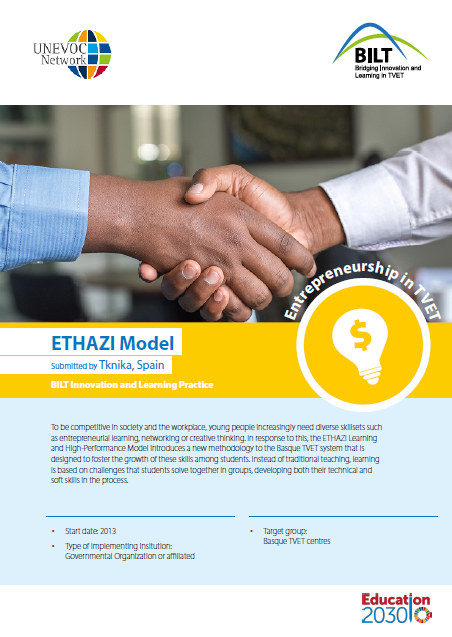
To be competitive in society and the workplace, young people increasingly need diverse skillsets such as entrepreneurial learning, networking or creative thinking. In response to this, the ETHAZI Learning and High-Performance Model introduces a new methodology to the Basque TVET system that is designed to foster the growth of these skills among students. Instead of traditional teaching, learning is based on challenges that students solve together in groups, developing both their technical and soft skills in the process.
| Institution: | TKNIKA |
| Country: | Spain |
| Focus: | New qualifications and competencies |


*Disclaimer: UNESCO-UNEVOC is not responsible for the management or implementation of any of the practices included in this database.

