


Innovative and Promising Practices in TVET
UNESCO-UNEVOC acts as a clearinghouse for innovative and promising practices in Technical and Vocational Education and Training (TVET). Each practice shows how TVET can be designed and delivered to address contextual challenges, presents the enabling conditions for success and provides a snapshot of the positive impact on communities. You can search by keyword, region or theme.
 Learn more about the three types of practices in our database
 Learn more about the three types of practices in our database
 Innovation and Learning Practices –
  i-hubs Innovative Practices – i-hubs practices are compiled in collaboration with 'Skills for innovation hubs' project partners and are based on the concept of innovation as outlined in UNESCO-UNEVOC's
  Promising Practices – TVET practices from around the world that have been implemented to address emerging challenges and to contribute to improving TVET teaching and learning in an inclusive way.
The use of augmented reality in offender learning
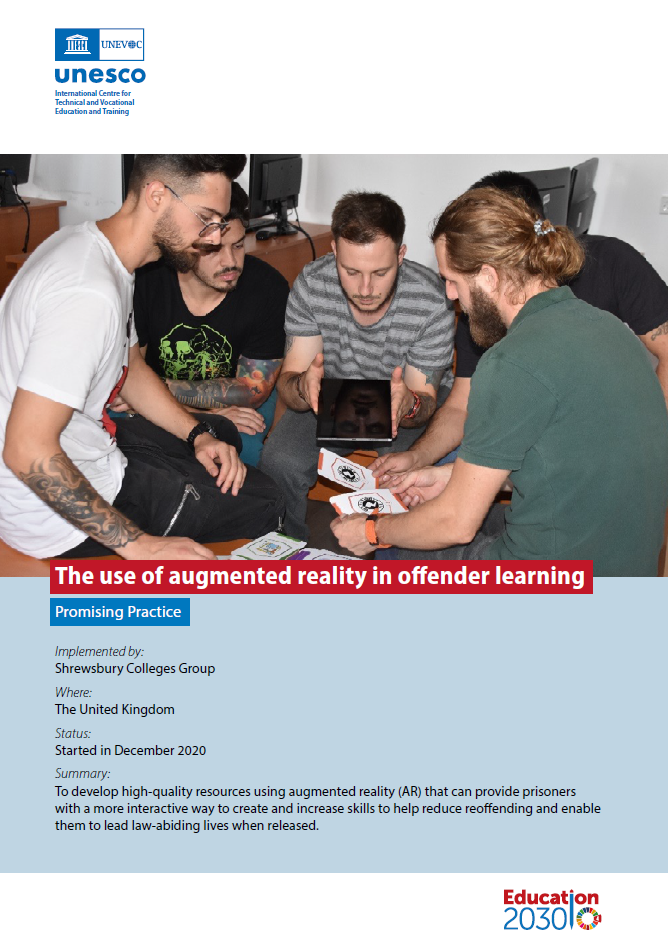
Research in the UK suggests that 81% of prison leavers receive no support in preparing for their release. This is one of the significant challenges that incarcerated individuals face as they try to rebuild their lives on the outside and become an integrated part of society. Post-release employment has been found to reduce the risk of reoffending by between a third and a half. However, most of the prison population has no stable employment experience. Further research recommends that employment programmes be based on strong local partnerships, with vocational training activities linked to real employment prospects.
Digital systems are crucial to enabling the delivery of high-quality education to prisoners. If prisoners are released to secure employment, continue to study, or otherwise contribute to society, they must be allowed to use and improve their digital skills in prison. Augmented reality will play an integral part in the offender learning revolution.
| Institution: | Shrewsbury Colleges Group |
| Country: | United Kingdom of Great Britain and Northern Ireland |
| Focus: | Digitalization and future of TVET , New qualifications and competencies |

*Disclaimer: UNESCO-UNEVOC is not responsible for the management or implementation of any of the practices included in this database.

