


Innovative and Promising Practices in TVET
UNESCO-UNEVOC acts as a clearinghouse for innovative and promising practices in Technical and Vocational Education and Training (TVET). Each practice shows how TVET can be designed and delivered to address contextual challenges, presents the enabling conditions for success and provides a snapshot of the positive impact on communities. You can search by keyword, region or theme.
 Learn more about the three types of practices in our database
 Learn more about the three types of practices in our database
 Innovation and Learning Practices –
 i-hubs Innovative Practices – i-hubs practices are compiled in collaboration with 'Skills for innovation hubs' project partners and are based on the concept of innovation as outlined in UNESCO-UNEVOC's
 Promising Practices – TVET practices from around the world that have been implemented to address emerging challenges and to contribute to improving TVET teaching and learning in an inclusive way.

AI in TVET: Starting small and scaling smart
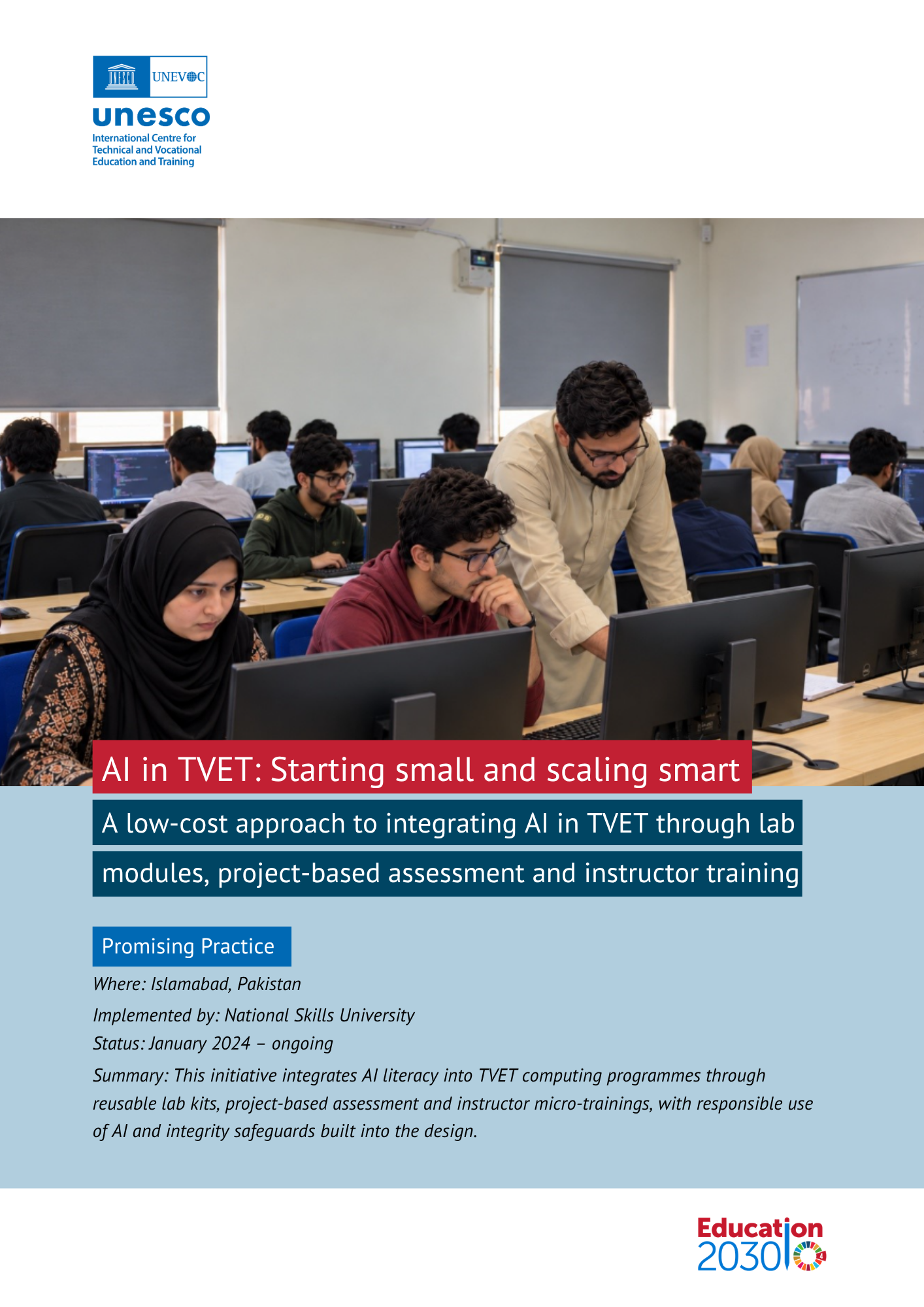
Rapid digitalization in Pakistan has increased demand for graduates and technicians who are comfortable working with artificial intelligence (AI) tools and workflows, creating a need to modernize TVET learning to remain practical and employability-focused. At the same time, the growing uptake of AI tools by TVET students brings new challenges regarding responsible use, academic integrity and basic security that need to be addressed.
In response to this gap, the National Skills University (NSU), a UNEVOC Centre, embedded AI literacy directly into existing computing programmes by adapting curricula, revising learning assessments and building instructor capacity, while keeping the approach budget-conscious and scalable.
| Institution: | National Skills University (NSU) |
| Country: | Pakistan |
| Focus: | Digitalization and future of TVET |

*Disclaimer: UNESCO-UNEVOC is not responsible for the management or implementation of any of the practices included in this database.


