An Overview of UNESCO-UNEVOC’s Digital Competence Framework Database
1. Why was this database of digital competence frameworks (DCFs) established?
An Overview of UNESCO-UNEVOC’s Digital Competence Framework Database
1. Why was this database of digital competence frameworks (DCFs) established?
This database was established as a global reference point for information on how digital competencies are being defined for citizens, learners and educators through the use of digital competence frameworks. The content is targeted to all types of UNEVOC Network members (national and international TVET policy-makers, researchers and practitioners - especially those interested in how digital skills are being defined). It aims to promote international discussion in topics related to digital competencies for TVET teachers, trainers and learners and to assist those wanting to design, implement, improve, and/or cooperate on their digital competence frameworks.
2. How were the DCFs identified and selected for inclusion in the database?
The DCFs included in the database were identified following a systematic process. The first stage was to perform a literature review to identify relevant digital skills/competence frameworks. A working definition of a ‘digital skills/competency framework’ was established and then key words associated with the definition identified to inform what should be included and excluded. Using these keywords, a review of the following electronic databases was undertaken: Web of Science, Scopus, ERIC and Education Search Complete, the TVET Country Profiles database and the Innovative and Promising Practices in TVET database.
DCFs identified were then sorted, coded and recorded in tabular form according to a set of criteria relevant to design, content and use of the DCFs. Feedback from experts on the initial coding terms was obtained, with adjustments made. The information regarding each DCF was then further analysed and edited for inclusion in the database.
3. Which organizations/government bodies are creating DCFs?
DCFs in the database have been developed by a diverse range of national governments, regional governments, government agencies, inter-governmental organizations, non-governmental organizations and foundations, and private sector companies. An overview of the DCFs in the UNESCO-UNEVOC online reference point reveals the range of actors who produce DCFs. Many are defined by national governments including for Austria; Australia; Canada; India; Indonesia; Norway; South Africa and the United Kingdom (both England and Wales). Others are defined internationally including by the European Union and UNESCO. There are examples of sector-based and occupational frameworks as well as those defined for teachers, citizens and learners (which can be in general or in vocational education).
4. Are there some common reasons for establishing Digital Competence Frameworks?
DFCs are commonly developed in response to the digital transformation across all spheres of social and economic life. Individuals throughout society have to be able to use digital tools and applications, and so require general knowledge and specific skills across a range of levels. Societies must support their citizens’ development of appropriate digital competency. DCFs have been developed as a way to identify, codify and systematize the digital knowledge, skills and attitudes required to function in a digital economy, society and within the labour market. They are produced to bring together in a common system the digital skills, knowledge, and attitudes which constitute digital competence.
However, as outlined, DCFs have been developed by a diverse range of organizations. Hence, while the different types of organizations who establish DCFs do so to support professionals or citizens to be able to better cope with the professional and personal demands placed on them by the proliferation of digital technology, they also have their own specific rationales and context. In the case of some of the DCFs developed by national governments, they have been produced to support or link with broader policy initiatives related to digital skills/engagement, for example.
5. To what extent are Digital Competence Frameworks specific to TVET?
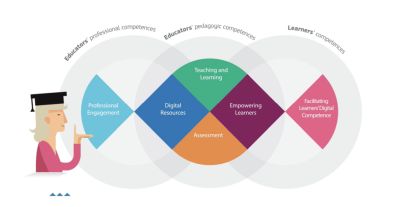
Of the DCFs included, only one is specific to TVET teachers and trainers: the Digital Teaching Professional Framework which has been developed by the Education and Training Foundation (ETF) in the United Kingdom (UK). The ETF is the workforce development body for teachers and trainers in the TVET sector in the UK funded by the Department of Education. There are other frameworks targeted at educator skills (e.g., the UNESCO ICT Competency Framework for teachers and the EU’s DigCompEdu.
Target groups differ by individual framework but include educators, citizens, learners and policy-makers. A common characteristic of all the frameworks is that they are designed to be generally relevant. Hence, even though the majority of frameworks do not focus specifically on TVET or make reference to TVET, they are relevant to policy-makers and educators in the TVET field or students on TVET courses. An exception to this is the Skills Framework for the Information Age targeted specifically at work in digital professions.
6. What is the relationship between the Digital Competence Frameworks in the database and broader policy and practice in digital skills and TVET?
For the majority of the DCFs in the repository, there is some evidence of linkages with broader policy and practices related to digital skills and/or TVET. These linkages differ across the frameworks. In some cases, the DCF sits within a broader programme or framework related to the development of digital or wider skills. For example, the Australian Foundation for your Future Digital Literacy Skills Framework has been developed to support the 'Foundation Skills for your Future Commonwealth Government Programme 2019'. This programme offers subsidized training for individuals to identify language, literacy, numeracy and digital (LLND) skill needs and enables eligible participants to access accredited or non-accredited training either in a traditional vocational education and training (VET) or workplace setting. The Digital Skills Competency Framework produced by the Welsh government is part of a set of cross-curricular skills frameworks which underpin the Curriculum for Wales alongside literacy and numeracy. In South Africa the Professional Development Framework for Digital Learning, aimed at teacher trainers, school leaders and teachers, e-learning specialists and curriculum subject specialists, is aligned with the Department of Basic Education’s strategic plan that encompasses all forms of training.
It would be expected that frameworks which are national, or produced by a region within a country, would have a link to broader polices given that they are produced by administrative bodies. The picture is more varied for those produced by international and non-governmental bodies or commercial enterprises/foundations. The latter are less connected to actual policies although they do attempt to nest themselves within the broader challenges facing nations and their citizens. The framework developed by the McKinsey Global Institute for example, is informed by a survey of 18,000 people in 15 countries in 2019. This research alongside academic research and McKinsey’s experience in adult training was used to identify a set of 56 foundational skills that will benefit all citizens across countries. Frameworks developed by international bodies, specifically UNESCO and the European Commission, are connected explicitly to the broader policy imperatives of these organizations. UNESCO for example has undertaken work on DCFs related to the Sustainable Development Goals (SDGs) and the European Commission’s DigComp 2.2. is designed to help in reaching the European Union’s policy targets of a minimum of 80% of the population of member states with basic digital skills and 20 million ICT specialists by 2030.
7. How is digital competence defined in the construction of the Digital Competence Frameworks?
Across the different DCFs, several terms are used to describe what is meant by digital competence and this term is used inter-changeably at times with terms such as digital literacy, digital knowledge, and digital attitudes. Hence, while similar terms are used to define digital competence, there is no one uniform definition adopted.
Given the range of organizations which have produced the DCFs and the differing levels of detail that the DCFs embody this is not surprising. An overview of the DCFs in the database overall though, indicates that digital competence is a multi-faceted concept that is context dependent. It involves technical skills as well as the ability to engage critically with the different facets of the digital world. This is evident in the definition used by the European Commission in the DigComp 2.2, for example:
‘Digital competence involves the confident, critical and responsible use of, and engagement with, digital technologies for learning, at work, and for participation in society. It includes information and data literacy, communication and collaboration, media literacy, digital content creation (including programming), safety (including digital well-being and competences related to cybersecurity), intellectual property related questions, problem solving and critical thinking.’
This definition is detailed and nuanced and captures well the competencies citizens need to be able to engage in society in a digital sense in the early 21st century. However, DigComp 2.2. itself must be see in context. It is one of the most detailed and thorough DCFs in the database designed to support the developments of competencies across a whole continent. Many of the DCFs do not actually provide a specific definition of digital competence. Rather, what digital competence means is embodied in the areas of competency/thematic areas which make up the DCF.
8. To what extent do the Digital Competence Frameworks in the database disaggregate digital competence by dimensions and levels of proficiency?
Every DCF in the database disaggregates digital competency to some extent. The majority of DCFs do so by outlining 4-5 dimensions and/or thematic areas. For example, the European Commission’s DigComp 2.2., aimed at citizens, has 5 dimensions:
- Information and data literacy;
- Communication and collaboration;
- Digital content creation;
- Safety; and
- Problem solving.
These dimensions are then sub-divided into 21 competencies. This structure (where dimensions or thematic areas are identified and then divided into a larger number of competencies) is common, characterizing over 70% of the DCFs in the database. The number of dimensions differs between 4 and 7 with competencies ranging from under 10 to over 30.
In terms of proficiency, around 60% of the frameworks are disaggregated into different levels. The number of levels ranges from 3 to 6. How such levels of proficiency are described is specific to each framework.
9. Are there provisions within Digital Competence Frameworks for specific regions and/or hard-to-reach groups?
More than 50% of DCFs do include some reference to accessibility and inclusion for those from lower socio-economic groups, people with disabilities, ethnic minorities or those from rural locations. However, these references are not very detailed and while some DCFs do include some specific sections, the recognition of the existence of divisions in access to digital technology in such sections is brief. As outlined in the article which can be found on the DCF repository site, challenges in access to digital technology by certain groups are multi-faceted and common across the world. As DCFs continue to develop, if they are to maximise their impact across societies, it is vital that they build into their design and delivery a greater understanding of these differences in access to digital technology that exist.


 An Overview of UNESCO-UNEVOC’s Digital Competence Framework Database