


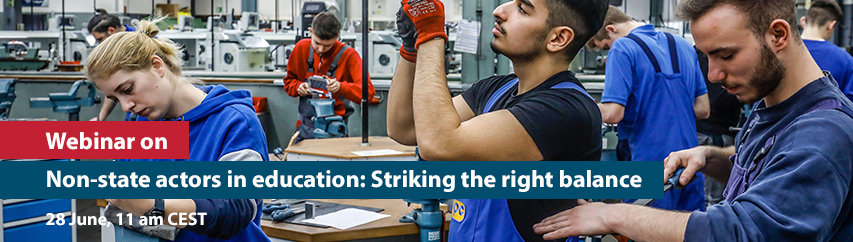
28 June, 11:00-12:30 CEST
Webinar
This webinar on "Striking the right balance: State and non-state engagement within technical and vocational education and training" was hosted by the GEM Report and UNESCO-UNEVOC. It examined some of the findings from the report’s analysis on non-state engagement in TVET systems and discussed current policies and initiatives designed to ensure quality, access and equity and what lessons they hold for policy-makers around the globe. #RightTheRules
- Present the report’s relevant findings and recommendations with key stakeholders.
- Explore concrete examples of approaches taken by countries to engage with non-state actors in TVET policies, regulations and partnerships, aimed to meet changing labour market and economic demands, while also ensuring equity and quality and what lessons can be drawn for others.
- Introduce the theme of the 2023 GEM Report on technology in education, an area in which there is high involvement and engagement of non-state actors within the TVET sector.
Webinar recording
Introduction
- Friedrich Huebler, Head of UNESCO-UNEVOC
- Francesca Endrizzi, Global Education Monitoring Report - Presentation
Private sector engagement for quality TVET: Lessons and experiences from the UNEVOC Network
Moderator: Jan Svihlik, Programme Expert on Loan (GIZ), Team Leader for Private Sector Engagement, UNESCO-UNEVOC
- Nazrene Mannie, Executive Director, Global Apprenticeship Network (GAN Global) - Presentation
- Matthews Phiri, Head of Strategy and Business Development, Human Resource Development Council (UNEVOC Centre), Botswana - Presentation
- Ahmed Samy, Executive Director of Strategy and Future, Higher Colleges of Technology (UNEVOC Centre), United Arab Emirates - Presentation
- Zhang Jing, Senior Director, Talent Partner Development of Huawei EBG - Presentation | Case study on collaboration with Shenzhen Polytechnic (UNEVOC Centre)
Resources

Global education monitoring report 2021/2: Non-state actors in education: who chooses? who loses?
Non-state actors’ role extends beyond provision of schooling to interventions at various education levels and influence spheres. Alongside its review of progress towards SDG 4, including emerging evidence on the COVID-19 pandemic’s impact, the 20 ...
 view
view  read more
Linking skills to needs with non-state actors – lessons from the 2021/2 GEM Report
Non-state actors are involved in all aspects of education. But for some levels of education, their presence is more evident and even necessary. Both formal and informal TVET are co-dependent on various private and non-state actors’ involvement for quality, effectiveness and relevance of training.
read more

