


Innovative and Promising Practices in TVET
UNESCO-UNEVOC acts as a clearinghouse for innovative and promising practices in Technical and Vocational Education and Training (TVET). Each practice shows how TVET can be designed and delivered to address contextual challenges, presents the enabling conditions for success and provides a snapshot of the positive impact on communities. You can search by keyword, region or theme.
 Learn more about the three types of practices in our database
 Learn more about the three types of practices in our database
 Innovation and Learning Practices –
  i-hubs Innovative Practices – i-hubs practices are compiled in collaboration with 'Skills for innovation hubs' project partners and are based on the concept of innovation as outlined in UNESCO-UNEVOC's
  Promising Practices – TVET practices from around the world that have been implemented to address emerging challenges and to contribute to improving TVET teaching and learning in an inclusive way.
Empowering rural women through ICT in TVET
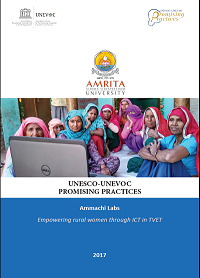
In India, women from rural communities often have little say in family and community decision-making. Skills development is a recognized medium of empowerment. However, access to TVET remains a challenge to a majority of those living in rural India. With the goal of empowering women, AMMACHI Labs offers a programme that uses innovative approaches and modern technology to overcome the obstacles rural women face in terms of access to TVET. In addition to developing in-demand vocational skills for the labour market (such as plumbing and fabric painting), life skills courses called Life Enrichment Education (LEE) are integrated into the training. LEE focuses on personal, family and community issues, and stimulates critical thinking and problem solving. AMMACHI Labs also deploys a Mobile Vocational Education (MoVe) van, which is equipped with ICT tools for education. As of 2017, the programme is active in 27 villages in 21 states. The programme has provided thousands of women with practical skills that have enhanced their earning potential and increased their capacity to participate in decision-making at the individual, family and community levels.
| Institution: | AMMACHI Labs, Amrita University |
| Country: | India |
| Funding: | Donor-based (funded in part by United Nations Democracy Fund (UNDEF) and in part by Amrita University |
| Focus: | Digitalization and future of TVET , Equity and inclusion |


*Disclaimer: UNESCO-UNEVOC is not responsible for the management or implementation of any of the practices included in this database.

