


Innovative and Promising Practices in TVET
UNESCO-UNEVOC acts as a clearinghouse for innovative and promising practices in Technical and Vocational Education and Training (TVET). Each practice shows how TVET can be designed and delivered to address contextual challenges, presents the enabling conditions for success and provides a snapshot of the positive impact on communities. You can search by keyword, region or theme.
 Learn more about the three types of practices in our database
 Learn more about the three types of practices in our database
 Innovation and Learning Practices –
  i-hubs Innovative Practices – i-hubs practices are compiled in collaboration with 'Skills for innovation hubs' project partners and are based on the concept of innovation as outlined in UNESCO-UNEVOC's
  Promising Practices – TVET practices from around the world that have been implemented to address emerging challenges and to contribute to improving TVET teaching and learning in an inclusive way.
Situation-based TVET using Virtual Reality
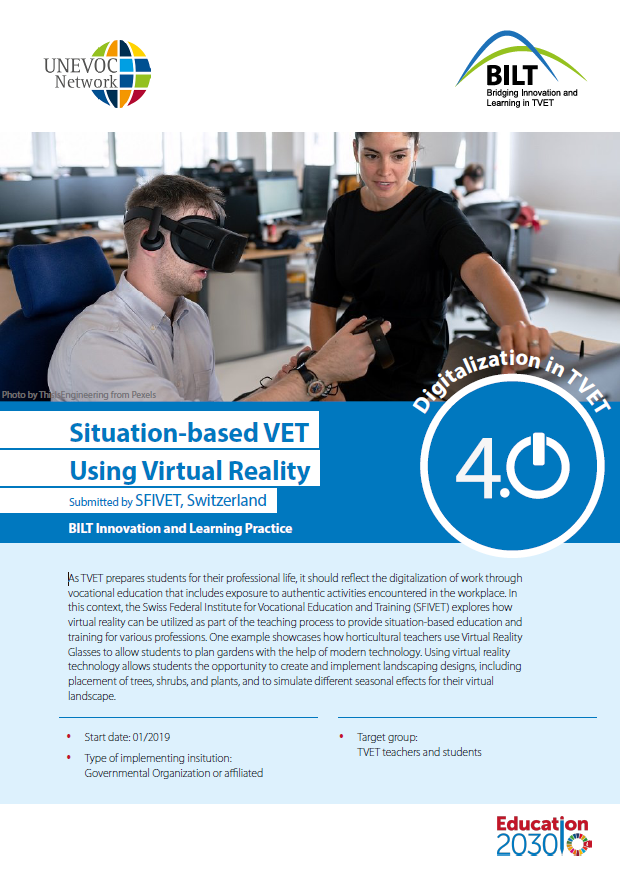
As TVET prepares students for their professional life, it should reflect the digitalization of work through vocational education that includes exposure to authentic activities encountered in the workplace. In this context, the Swiss Federal Institute for Vocational Education and Training (SFIVET) explores how virtual reality can be utilized as part of the teaching process to provide situation-based education and training for various professions. One example showcases how horticultural teachers use Virtual Reality Glasses to allow students to plan gardens with the help of modern technology. Using virtual reality technology allows students the opportunity to create and implement landscaping designs, including placement of trees, shrubs, and plants, and to simulate different seasonal effects for their virtual landscape.
| Institution: | Swiss Federal Institute for Vocational Education and Training |
| Country: | Switzerland |
| Focus: | Digitalization and future of TVET |


*Disclaimer: UNESCO-UNEVOC is not responsible for the management or implementation of any of the practices included in this database.

