


Innovative and Promising Practices in TVET
UNESCO-UNEVOC acts as a clearinghouse for innovative and promising practices in Technical and Vocational Education and Training (TVET). Each practice shows how TVET can be designed and delivered to address contextual challenges, presents the enabling conditions for success and provides a snapshot of the positive impact on communities. You can search by keyword, region or theme.
 Learn more about the three types of practices in our database
 Learn more about the three types of practices in our database
 Innovation and Learning Practices –
  i-hubs Innovative Practices – i-hubs practices are compiled in collaboration with 'Skills for innovation hubs' project partners and are based on the concept of innovation as outlined in UNESCO-UNEVOC's
  Promising Practices – TVET practices from around the world that have been implemented to address emerging challenges and to contribute to improving TVET teaching and learning in an inclusive way.
Training with integrated language learning
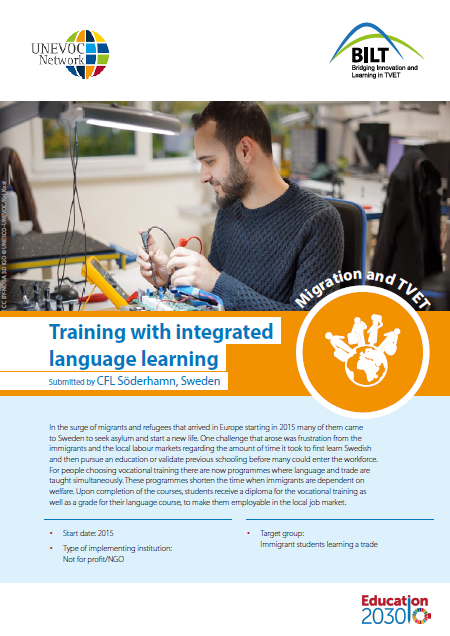
In the surge of migrants and refugees that arrived in Europe starting in 2015, many of them came to Sweden to seek asylum and start a new life. One challenge that arose was frustration from the immigrants and the local labour markets regarding the amount of time it took to first learn Swedish and then pursue an education or validate previous schooling before many could enter the workforce. For people choosing vocational training, there are now programmes where language and trade are taught simultaneously. These programmes shorten the time when immigrants are dependent on welfare. Upon completion of the courses, students receive a diploma for the vocational training as well as a grade for their language course, to make them employable in the local job market.
| Institution: | Centre for Flexible Learning (CFL) Söderhamn |
| Country: | Sweden |
| Focus: | Migration |


*Disclaimer: UNESCO-UNEVOC is not responsible for the management or implementation of any of the practices included in this database.

