


Innovative and Promising Practices in TVET
UNESCO-UNEVOC acts as a clearinghouse for innovative and promising practices in Technical and Vocational Education and Training (TVET). Each practice shows how TVET can be designed and delivered to address contextual challenges, presents the enabling conditions for success and provides a snapshot of the positive impact on communities. You can search by keyword, region or theme.
 Learn more about the three types of practices in our database
 Learn more about the three types of practices in our database
 Innovation and Learning Practices –
  i-hubs Innovative Practices – i-hubs practices are compiled in collaboration with 'Skills for innovation hubs' project partners and are based on the concept of innovation as outlined in UNESCO-UNEVOC's
  Promising Practices – TVET practices from around the world that have been implemented to address emerging challenges and to contribute to improving TVET teaching and learning in an inclusive way.
Sri Lanka National Skills Passport Project
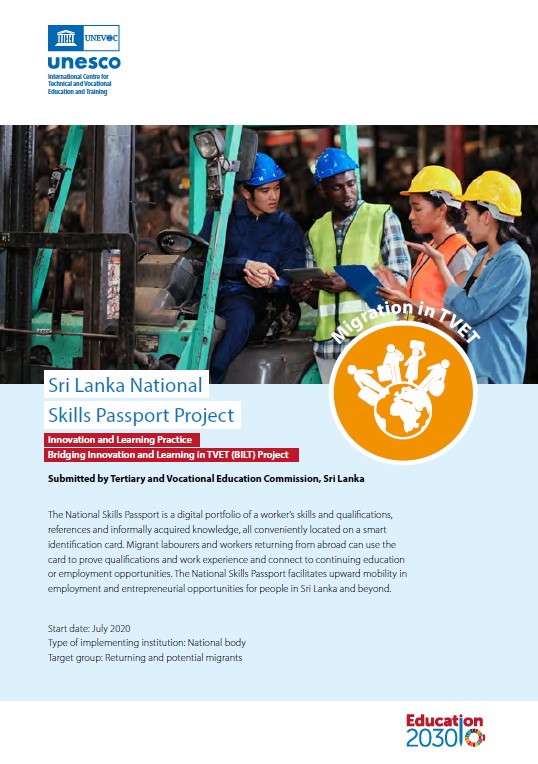
The National Skills Passport is a digital portfolio of a worker’s skills and qualifications, references and informally acquired knowledge, all conveniently located on a smart identification card. Migrant labourers and workers returning from abroad can use the card to prove qualifications and work experience and connect to continuing education or employment opportunities. The National Skills Passport facilitates upward mobility in employment and entrepreneurial opportunities for people in Sri Lanka and beyond.
| Institution: | Tertiary and Vocational Education Commission |
| Country: | Sri Lanka |
| Focus: | Migration |


*Disclaimer: UNESCO-UNEVOC is not responsible for the management or implementation of any of the practices included in this database.

