


Innovative and Promising Practices in TVET
UNESCO-UNEVOC acts as a clearinghouse for innovative and promising practices in Technical and Vocational Education and Training (TVET). Each practice shows how TVET can be designed and delivered to address contextual challenges, presents the enabling conditions for success and provides a snapshot of the positive impact on communities. You can search by keyword, region or theme.
 Learn more about the three types of practices in our database
 Learn more about the three types of practices in our database
 Innovation and Learning Practices –
  i-hubs Innovative Practices – i-hubs practices are compiled in collaboration with 'Skills for innovation hubs' project partners and are based on the concept of innovation as outlined in UNESCO-UNEVOC's
  Promising Practices – TVET practices from around the world that have been implemented to address emerging challenges and to contribute to improving TVET teaching and learning in an inclusive way.
MilleaLab - The all-in-one VR platform for education
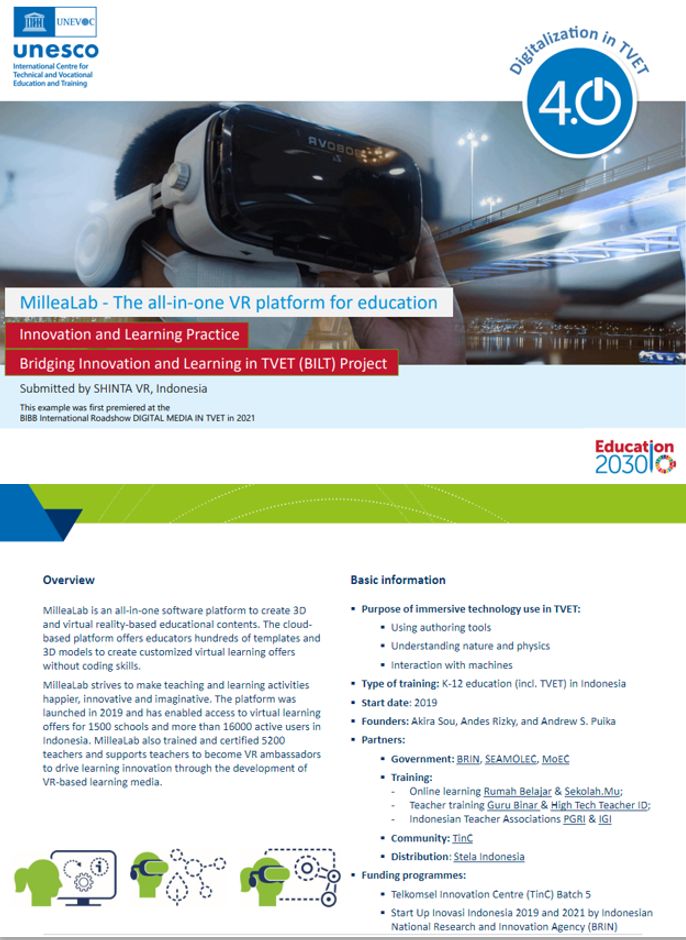
MilleaLab is an all-in-one software platform to create 3D and virtual reality-based educational contents. The cloud-based platform offers educators hundreds of templates and 3D models to create customized virtual learning offers without coding skills.
MilleaLab strives to make teaching and learning activities happier, innovative and imaginative. The platform was launched in 2019 and has enabled access to virtual learning offers for 1500 schools and more than 16000 active users in Indonesia. MilleaLab also trained and certified 5200 teachers and supports teachers to become VR ambassadors to drive learning innovation through the development of VR-based learning media.
To view the BILT Learning Lab focused on the MilleaLab virtual reality platform and its related materials please visit: https://connect.unevoc.unesco.org/bilt/Learning-Lab-MilleaLab
| Institution: | SHINTA VR |
| Country: | Indonesia |
| Focus: | Digitalization and future of TVET |

*Disclaimer: UNESCO-UNEVOC is not responsible for the management or implementation of any of the practices included in this database.

