


Innovative and Promising Practices in TVET
UNESCO-UNEVOC acts as a clearinghouse for innovative and promising practices in Technical and Vocational Education and Training (TVET). Each practice shows how TVET can be designed and delivered to address contextual challenges, presents the enabling conditions for success and provides a snapshot of the positive impact on communities. You can search by keyword, region or theme.
 Learn more about the three types of practices in our database
 Learn more about the three types of practices in our database
 Innovation and Learning Practices –
  i-hubs Innovative Practices – i-hubs practices are compiled in collaboration with 'Skills for innovation hubs' project partners and are based on the concept of innovation as outlined in UNESCO-UNEVOC's
  Promising Practices – TVET practices from around the world that have been implemented to address emerging challenges and to contribute to improving TVET teaching and learning in an inclusive way.
“Smart Class” for more effective teaching and learning
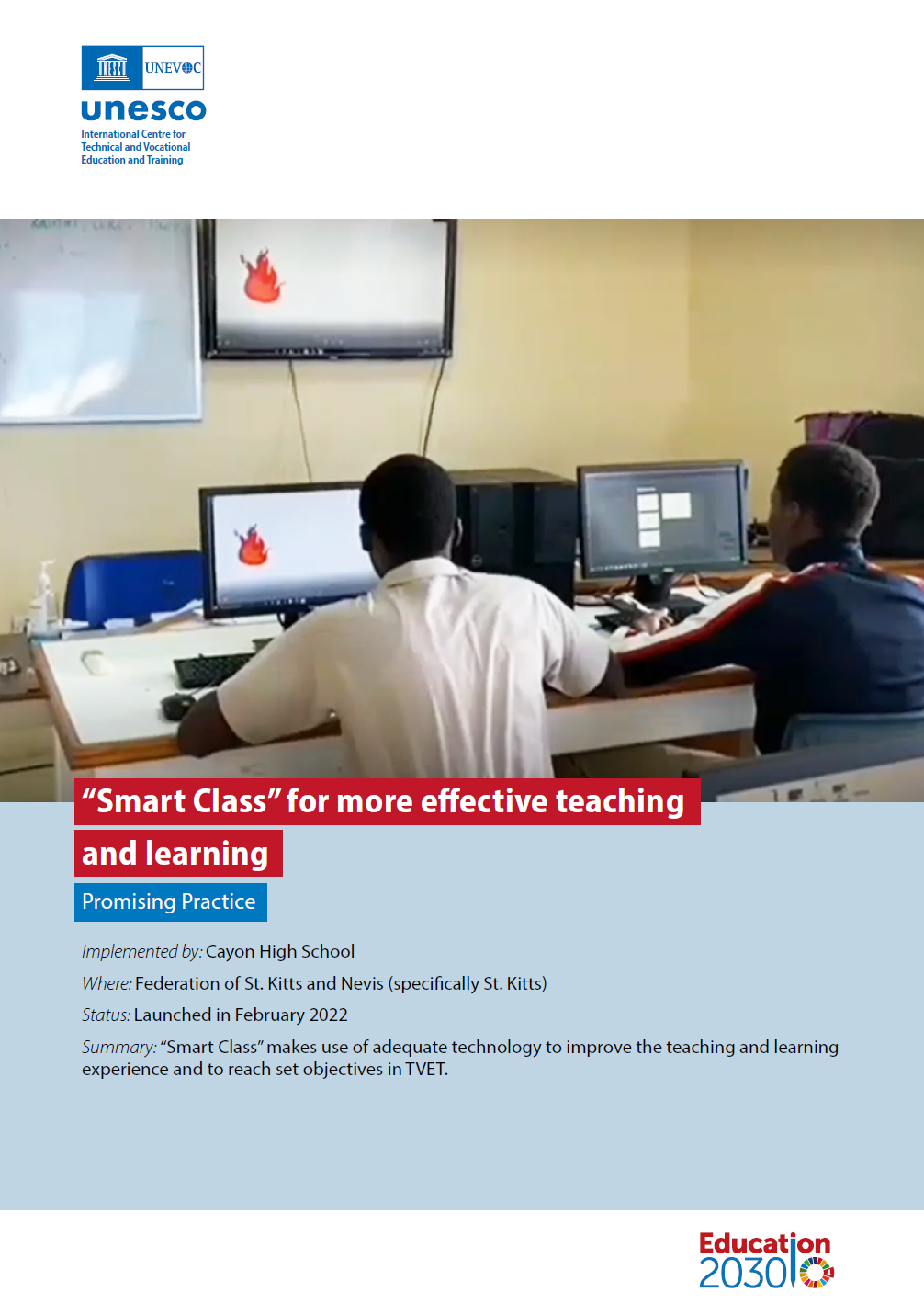
“Smart Class” makes use of adequate technology to improve the teaching and learning experience and to reach set objectives in TVET.
This initiative is based on resourcefulness to provide a better teaching and learning environment at Cayon High School. The school first evaluated the existing classroom environment by asking teachers and students alike. Several difficulties faced during teaching and learning activities at the school were identified.
To improve this situation, the TVET teachers looked for and found TV monitors that were being used for security surveillance and obtained temporary permission to have them installed in the classroom. This allowed teachers to link their PC to the monitors which enabled step-by-step instructions being issued to all students at once, hence reaching the students more effectively and efficiently.
| Institution: | Cayon High School |
| Country: | Saint Kitts and Nevis |
| Focus: | Digitalization and future of TVET |

*Disclaimer: UNESCO-UNEVOC is not responsible for the management or implementation of any of the practices included in this database.

