


Innovative and Promising Practices in TVET
UNESCO-UNEVOC acts as a clearinghouse for innovative and promising practices in Technical and Vocational Education and Training (TVET). Each practice shows how TVET can be designed and delivered to address contextual challenges, presents the enabling conditions for success and provides a snapshot of the positive impact on communities. You can search by keyword, region or theme.
 Learn more about the three types of practices in our database
 Learn more about the three types of practices in our database
 Innovation and Learning Practices –
  i-hubs Innovative Practices – i-hubs practices are compiled in collaboration with 'Skills for innovation hubs' project partners and are based on the concept of innovation as outlined in UNESCO-UNEVOC's
  Promising Practices – TVET practices from around the world that have been implemented to address emerging challenges and to contribute to improving TVET teaching and learning in an inclusive way.
e-Learning and training – the art of hospitality
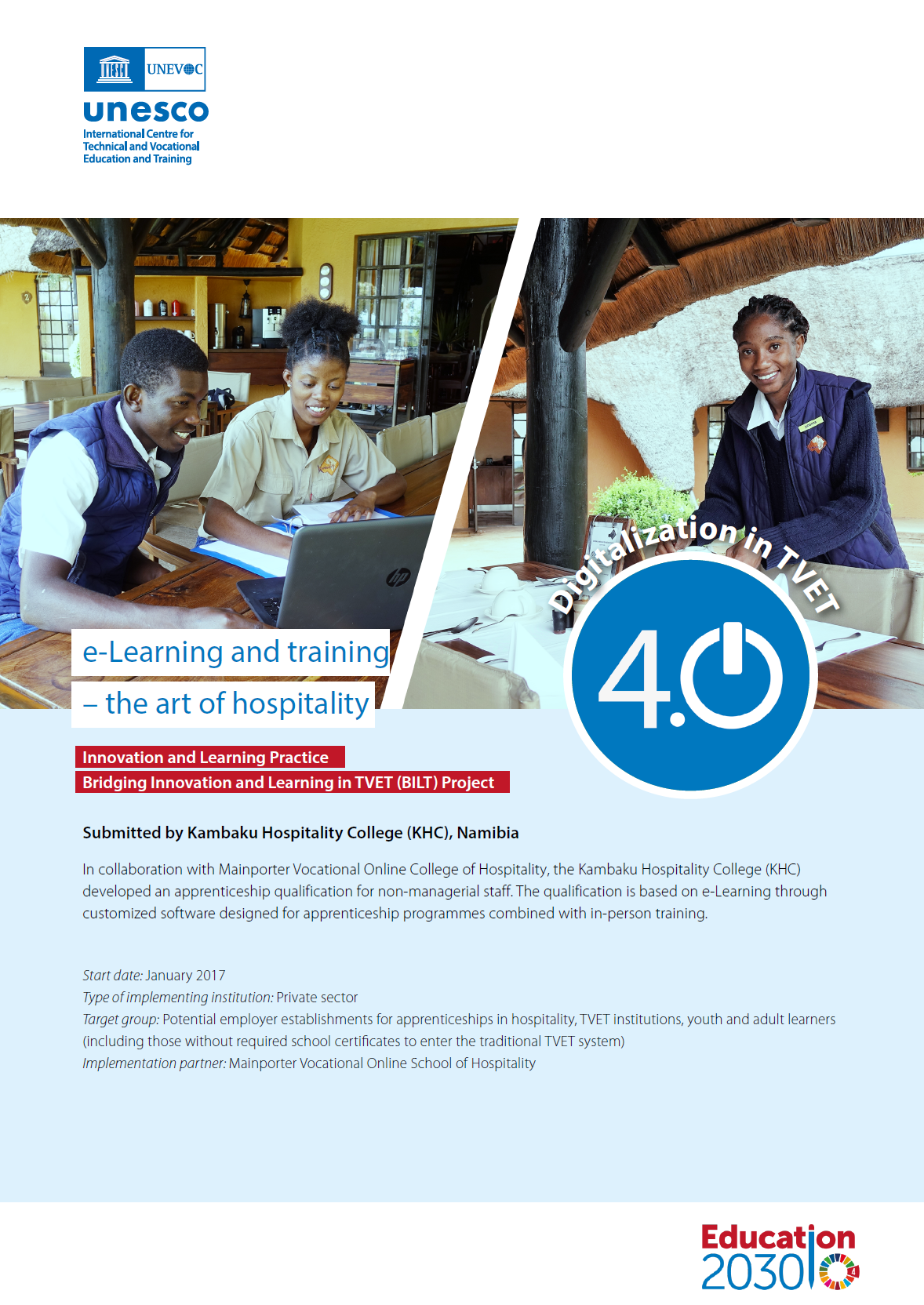
In collaboration with Mainporter Vocational Online College of Hospitality, the Kambaku Hospitality College (KHC) developed an apprenticeship qualification for non-managerial staff. The qualification is based on e-Learning through customized software designed for apprenticeship programmes combined with in-person training.
Through its unique online system, KHC provides accessible education and skills training for people and companies working and operating in areas remote from traditional vocational training centres, and without highly skilled practical trainers.
This initiative was developed by industry for industry, erasing the previous disconnect between training received and skills required. Providing learners with mentors working within the hospitality sector allows them to be guided in line with first-hand, current knowledge of the industry.
| Institution: | Kambaku Hospitality College (KHC) |
| Country: | Namibia |
| Focus: | Digitalization and future of TVET |

*Disclaimer: UNESCO-UNEVOC is not responsible for the management or implementation of any of the practices included in this database.

