


Innovative and Promising Practices in TVET
UNESCO-UNEVOC acts as a clearinghouse for innovative and promising practices in Technical and Vocational Education and Training (TVET). Each practice shows how TVET can be designed and delivered to address contextual challenges, presents the enabling conditions for success and provides a snapshot of the positive impact on communities. You can search by keyword, region or theme.
 Learn more about the three types of practices in our database
 Learn more about the three types of practices in our database
 Innovation and Learning Practices –
  i-hubs Innovative Practices – i-hubs practices are compiled in collaboration with 'Skills for innovation hubs' project partners and are based on the concept of innovation as outlined in UNESCO-UNEVOC's
  Promising Practices – TVET practices from around the world that have been implemented to address emerging challenges and to contribute to improving TVET teaching and learning in an inclusive way.
MYSEA – Mediterranean Youth, NEETs and Women advancing Skills, Employment and Awareness in the blue and green economy
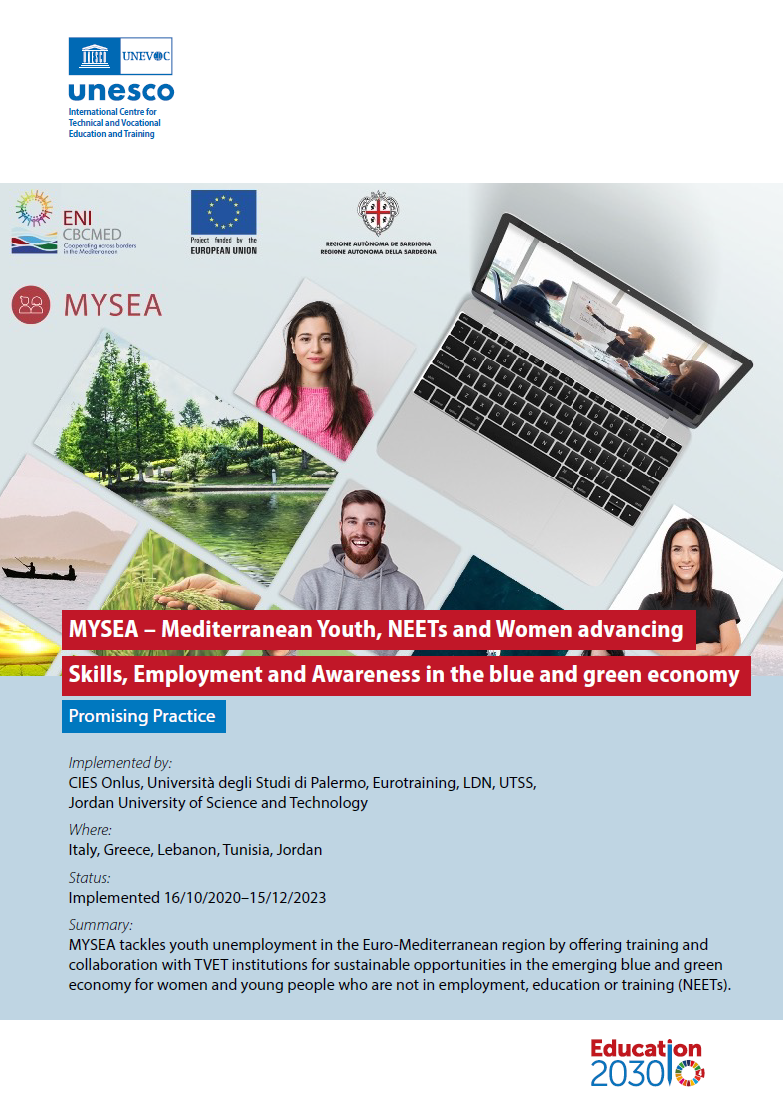
MYSEA project responds to unemployment by transforming borders into a possibility for cooperation and development. It brings together countries to identify and address common challenges and opportunities. All countries experimented and delivered trainings both online and in-person, complemented with a dedicated platform and engaging activities (coaching and mentoring sessions).
The core initiative of the project focused on planning and implementing a shared training pathway for all participating countries – Italy, Greece, Lebanon, Tunisia and Jordan. The primary goal was to narrow the gap between labour demand and supply in the emerging blue and green economic sectors. The development of the training curricula was shaped by research involving enterprises, technical and vocational education and training (TVET) institutions, and potential beneficiaries, aiming to identify the emerging skills and professional needs within the agri-food and waste management production sectors.
| Institution: | CIES Onlus, Università degli Studi di Palermo, Eurotraining, LDN, UTSS, Jordan University of Science and Technology |
| Country: | |
| Focus: | Greening TVET , New qualifications and competencies , Youth and entrepreneurship |

*Disclaimer: UNESCO-UNEVOC is not responsible for the management or implementation of any of the practices included in this database.

