


Innovative and Promising Practices in TVET
UNESCO-UNEVOC acts as a clearinghouse for innovative and promising practices in Technical and Vocational Education and Training (TVET). Each practice shows how TVET can be designed and delivered to address contextual challenges, presents the enabling conditions for success and provides a snapshot of the positive impact on communities. You can search by keyword, region or theme.
 Learn more about the three types of practices in our database
 Learn more about the three types of practices in our database
 Innovation and Learning Practices –
  i-hubs Innovative Practices – i-hubs practices are compiled in collaboration with 'Skills for innovation hubs' project partners and are based on the concept of innovation as outlined in UNESCO-UNEVOC's
  Promising Practices – TVET practices from around the world that have been implemented to address emerging challenges and to contribute to improving TVET teaching and learning in an inclusive way.
Electric vehicle train-the-trainer programme
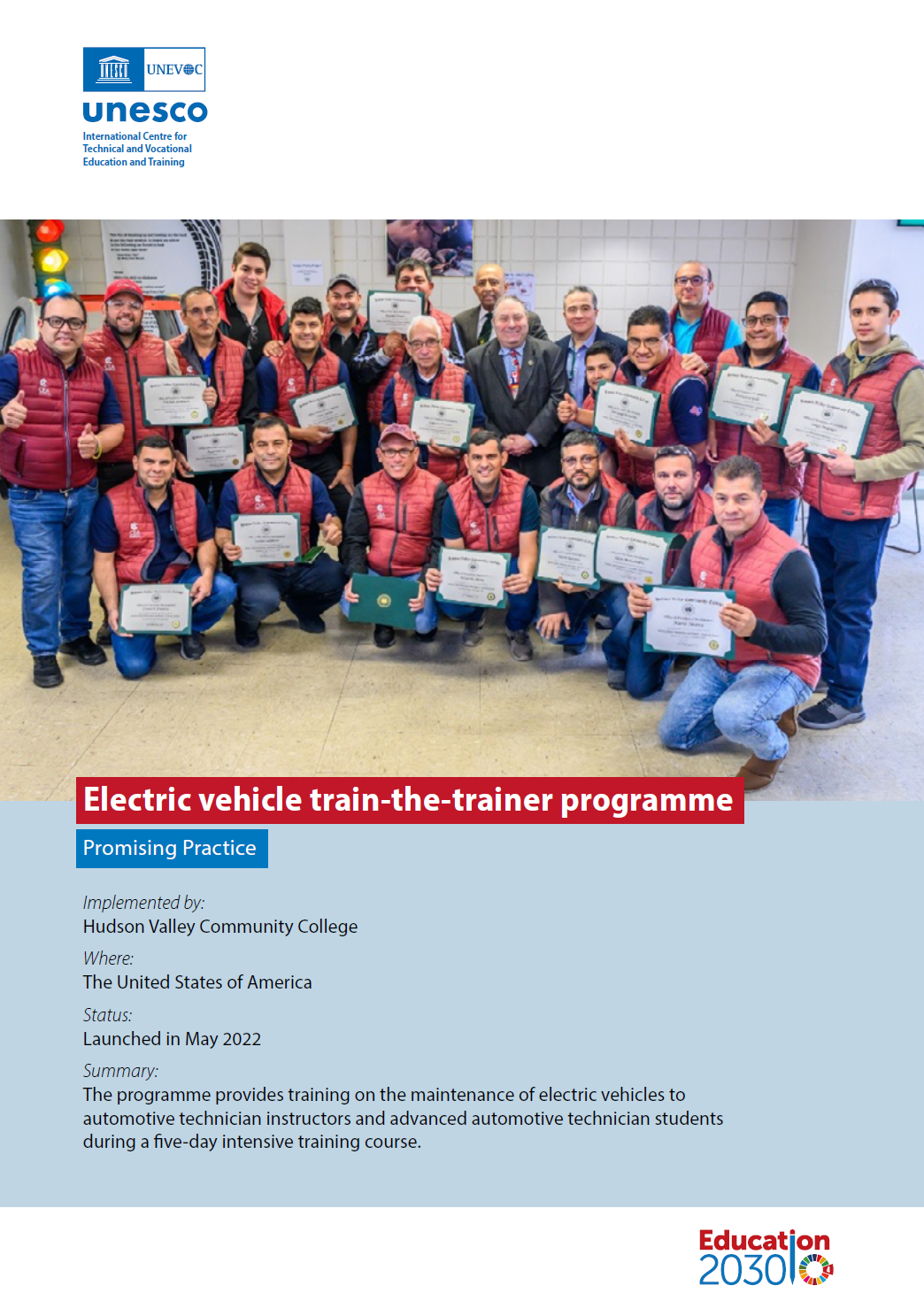
Hudson Valley Community College collaborated with the Corporación Educativa Automotriz (CEA) from Costa Rica to develop a five-day intensive electric vehicle train-the-trainer programme for their automotive technician instructors. The course contains introductory lectures to present the theory and operation of EVs and HEVs, laboratory experiments and computer workshops.
The initial objective of the initiative was to provide training to CEA’s Automotive Instructors to assist them in teaching analytical and hands-on skills in diagnosing and repairing Hybrid Electric Vehicles (HEVs) and EVs to their students while also introducing autonomous and semi-autonomous vehicles. However, the objective of the programme has expanded. The second cohort of participants included advanced automotive technician students and participants from other countries, namely El Salvador, Ecuador and Mexico.
| Institution: | Hudson Valley Community College |
| Country: | United States of America |
| Focus: | Teachers and trainers |

*Disclaimer: UNESCO-UNEVOC is not responsible for the management or implementation of any of the practices included in this database.

