


Innovative and Promising Practices in TVET
UNESCO-UNEVOC acts as a clearinghouse for innovative and promising practices in Technical and Vocational Education and Training (TVET). Each practice shows how TVET can be designed and delivered to address contextual challenges, presents the enabling conditions for success and provides a snapshot of the positive impact on communities. You can search by keyword, region or theme.
 Learn more about the three types of practices in our database
 Learn more about the three types of practices in our database
 Innovation and Learning Practices –
  i-hubs Innovative Practices – i-hubs practices are compiled in collaboration with 'Skills for innovation hubs' project partners and are based on the concept of innovation as outlined in UNESCO-UNEVOC's
  Promising Practices – TVET practices from around the world that have been implemented to address emerging challenges and to contribute to improving TVET teaching and learning in an inclusive way.
The FlexScan
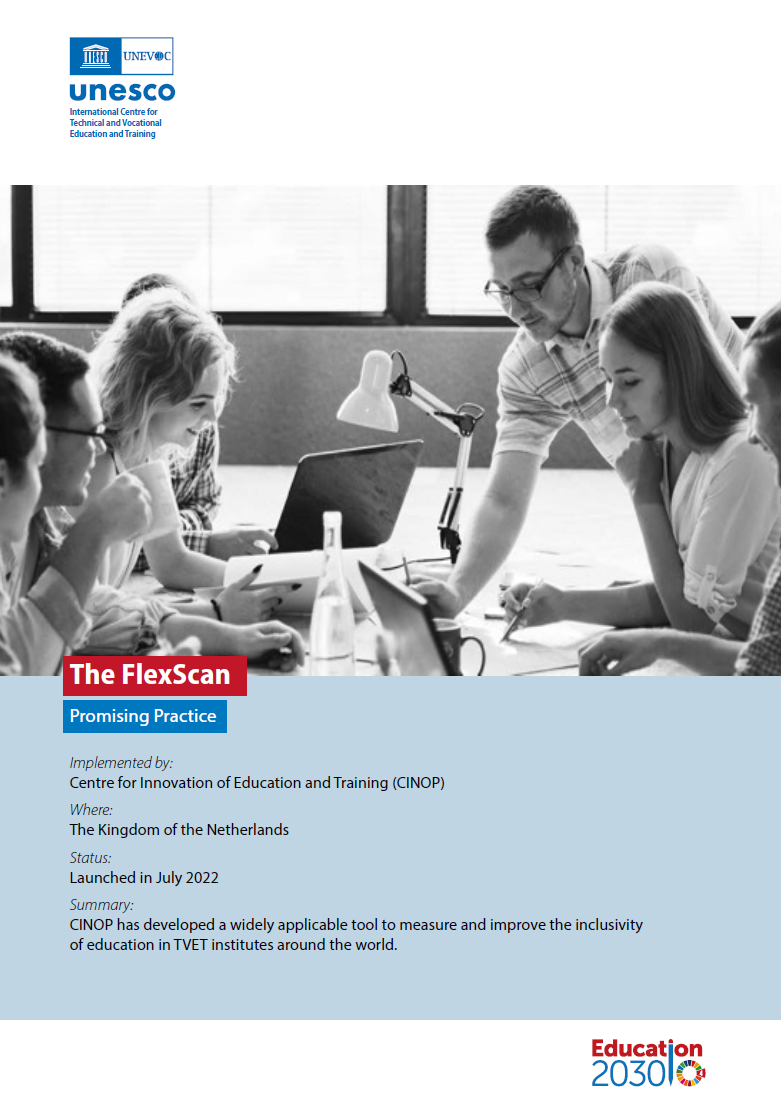
CINOP has developed a widely applicable tool to measure and improve the inclusivity of education in TVET institutes around the world. The FlexScan has been developed in the context of the Learning Outcomes experiments. Through these experiments, the aim is to investigate how education can become more flexible.
The assumption is that making education more flexible for a more diversified target audience, particularly those who are employed, will lead to increased participation of working individuals in education and the issuance of more diplomas or formal recognition of their learning. This is necessary to achieve the government’s goal of (re-)educating a larger portion of the workforce at a higher level. A better offer in flexible part-time education should make it possible to develop more customized learning experiences, aligning with the student’s prior education, work experience, workplace and interests.
| Institution: | Centre for Innovation of Education and Training (CINOP) |
| Country: | Netherlands, Kingdom of the |
| Focus: |

*Disclaimer: UNESCO-UNEVOC is not responsible for the management or implementation of any of the practices included in this database.

