


Innovative and Promising Practices in TVET
UNESCO-UNEVOC acts as a clearinghouse for innovative and promising practices in Technical and Vocational Education and Training (TVET). Each practice shows how TVET can be designed and delivered to address contextual challenges, presents the enabling conditions for success and provides a snapshot of the positive impact on communities. You can search by keyword, region or theme.
 Learn more about the three types of practices in our database
 Learn more about the three types of practices in our database
 Innovation and Learning Practices –
  i-hubs Innovative Practices – i-hubs practices are compiled in collaboration with 'Skills for innovation hubs' project partners and are based on the concept of innovation as outlined in UNESCO-UNEVOC's
  Promising Practices – TVET practices from around the world that have been implemented to address emerging challenges and to contribute to improving TVET teaching and learning in an inclusive way.
Basic Education Equivalency Programme (BEEP)
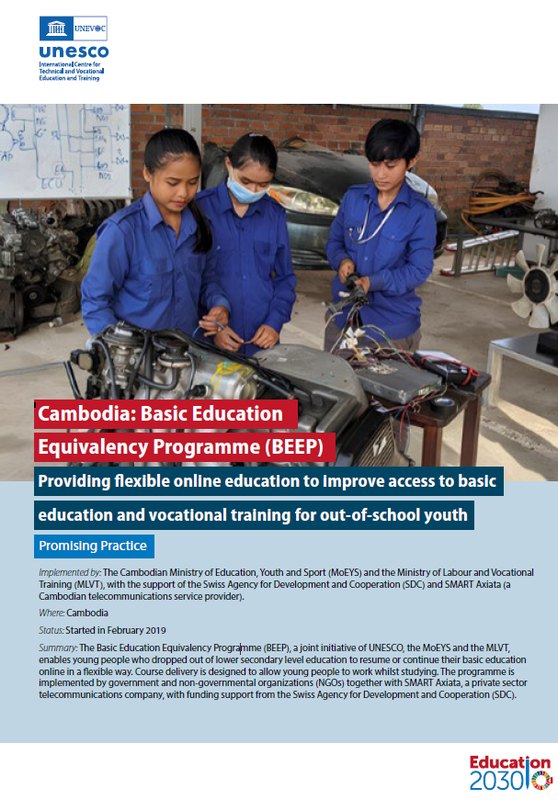
The Basic Education Equivalency Programme (BEEP), a joint initiative of UNESCO, the MoEYS and the MLVT, enables young people who dropped out of lower secondary level education to resume or continue their basic education online in a flexible way. Course delivery is designed to allow young people to work whilst studying. The programme is implemented by government and non-governmental organizations (NGOs) together with SMART Axiata, a private sector telecommunications company, with funding support from the Swiss Agency for Development and Cooperation (SDC).
| Institution: | The Cambodian Ministry of Education, Youth and Sport (MoEYS) and the Ministry of Labour and Vocational Training (MLVT) |
| Country: | Cambodia |
| Focus: | Equity and inclusion |


*Disclaimer: UNESCO-UNEVOC is not responsible for the management or implementation of any of the practices included in this database.

