


Innovative and Promising Practices in TVET
UNESCO-UNEVOC acts as a clearinghouse for innovative and promising practices in Technical and Vocational Education and Training (TVET). Each practice shows how TVET can be designed and delivered to address contextual challenges, presents the enabling conditions for success and provides a snapshot of the positive impact on communities. You can search by keyword, region or theme.
 Learn more about the three types of practices in our database
 Learn more about the three types of practices in our database
 Innovation and Learning Practices –
 i-hubs Innovative Practices – i-hubs practices are compiled in collaboration with 'Skills for innovation hubs' project partners and are based on the concept of innovation as outlined in UNESCO-UNEVOC's
 Promising Practices – TVET practices from around the world that have been implemented to address emerging challenges and to contribute to improving TVET teaching and learning in an inclusive way.

ASSET: AI for skills, sustainability and training
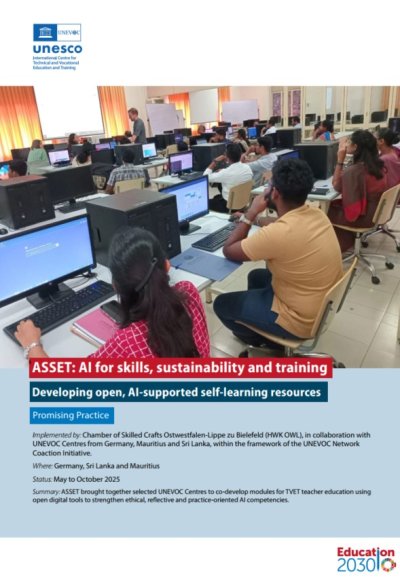
The rapid advancement of AI is transforming TVET and increasing the need for TVET educators to develop new competencies for integrating AI into teaching and learning. While AI offers significant opportunities to enhance teaching practice, TVET educators often lack access to open, adaptable professional development that addresses both practical application and ethical considerations.
ASSET was developed by the Chamber of Skilled Crafts Ostwestfalen-Lippe zu Bielefeld (HWK OWL), a UNEVOC Centre, through the UNEVOC Network Coaction Initiative. The initiative is implemented in collaboration with three other UNEVOC Centres:
• UNEVOC Centre “TVET for Sustainable Development” (Otto von Guericke University Magdeburg, Deutsche Gesellschaft für Internationale Zusammenarbeit (GIZ) GmbH and Fraunhofer Institute for Factory Operation and Automation), Germany
• Human Resource Development Council (HRDC), Mauritius
• University of Vocational Technology (UNIVOTEC), Sri Lanka
| Institution: | Chamber of Skilled Crafts Ostwestfalen-Lippe zu Bielefeld (HWK OWL); UNEVOC Centre “TVET for Sustainable Development”, Germany; Human Resource Development Council (HRDC), Mauritius; University of Vocational Technology (UNIVOTEC), Sri Lanka |
| Country: | |
| Focus: | Digitalization and future of TVET , New qualifications and competencies , Teachers and trainers |

*Disclaimer: UNESCO-UNEVOC is not responsible for the management or implementation of any of the practices included in this database.


