Bibliothèque en ligne de l'UNEVOC
 Voir
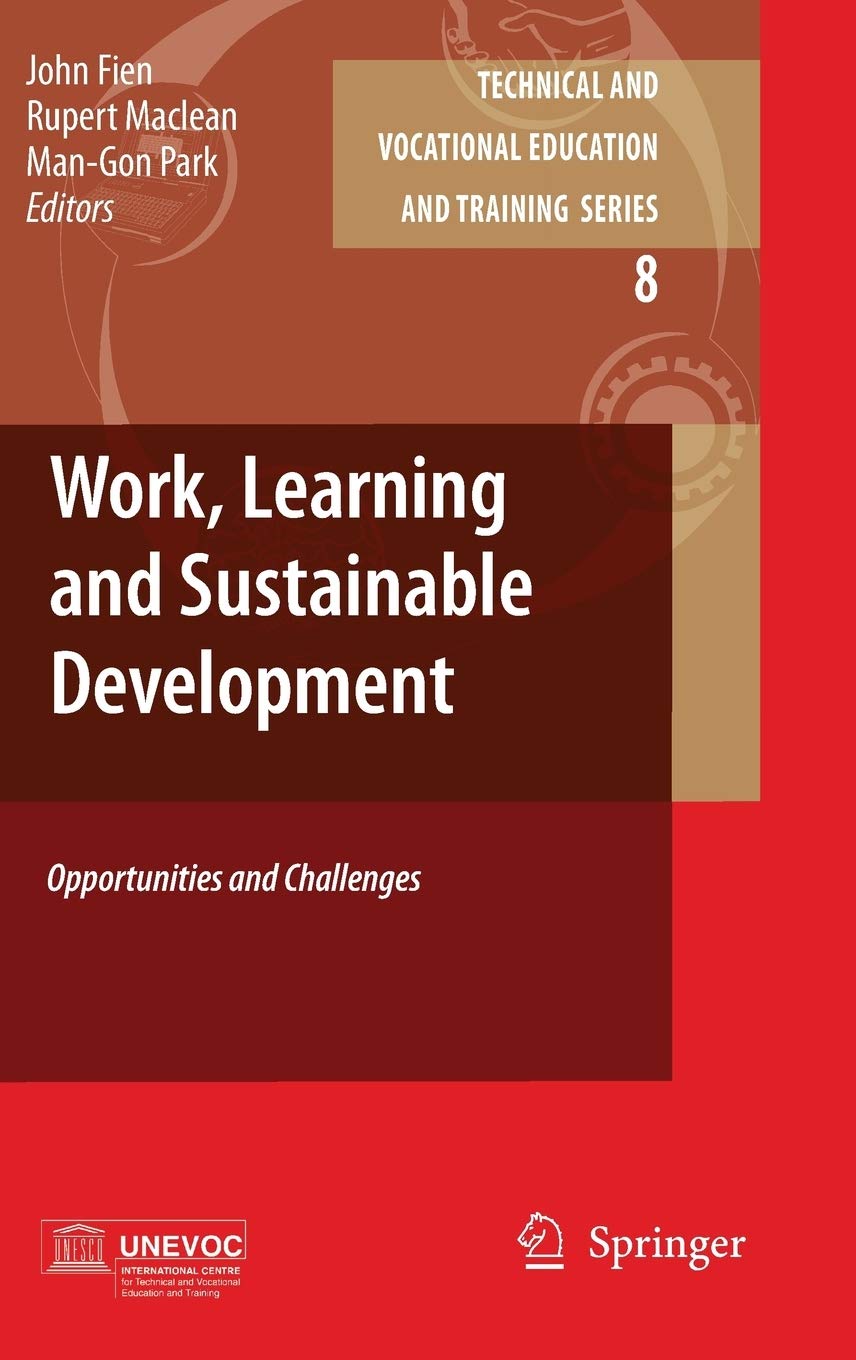
Voir| Author/s: | John Fien, Rupert Maclean, Man-Gon Park (Eds.) |
| Co-Author/s: | UNESCO-UNEVOC |
| Éditeur: | Springer Science and Business Media |
| Publié: | 2009 in Dordrecht, Netherlands, Kingdom of the |
| Licence: |  Standard copyright - All rights reserved |
| ISBN: | 978-1-4020-8193-4 |
| ULC: | UNEVOC Library Catalogue ID 2307 |

Work, Learning and Sustainable Development
Opportunities and ChallengesThis UNESCO-UNEVOC publication is the first that provides a comprehensive overview of the way countries, education systems and institutions have responded to the call for an integration of learning for work, citizenship and sustainability at the Second International Conference on Technical and Vocational Education which was held in Seoul in 1999. Discussions on the central theme of the Seoul Conference - lifelong learning and training for all, a bridge to the future led to the conclusion that a new paradigm of both development and Technical and Vocational Education (TVET) was needed.
This book showcases the wide range of international initiatives that have sought to put such exhortations into practice. It includes: case studies of national TVET policy reforms, reoriented curricula, sustainable campus management programs, and examples of innovative approaches to integrating learning in TVET with on-the-job training and in community service. It also focuses on the issues and challenges being faced and ways of moving forward.
Case studies feature initiatives in a wide range of world regions and countries, and include authors from: UK, Germany, Finland, Canada, USA, Australia, South Africa, China, Republic of Korea, India, Pakistan and the Philippines.
Written for: TVET policy makers, curriculum writers, administrators, teachers, lecturers and researchers
share on