Logo UNESCO-UNEVOC UNEVOC International Centre for TVET

Skills for work and life

Transforming technical and vocational education and training (TVET) for successful and just transitions

open menu
Logo UNESCO-UNEVOC

International Centre for TVET (UNEVOC)


Barriers to digital skills development

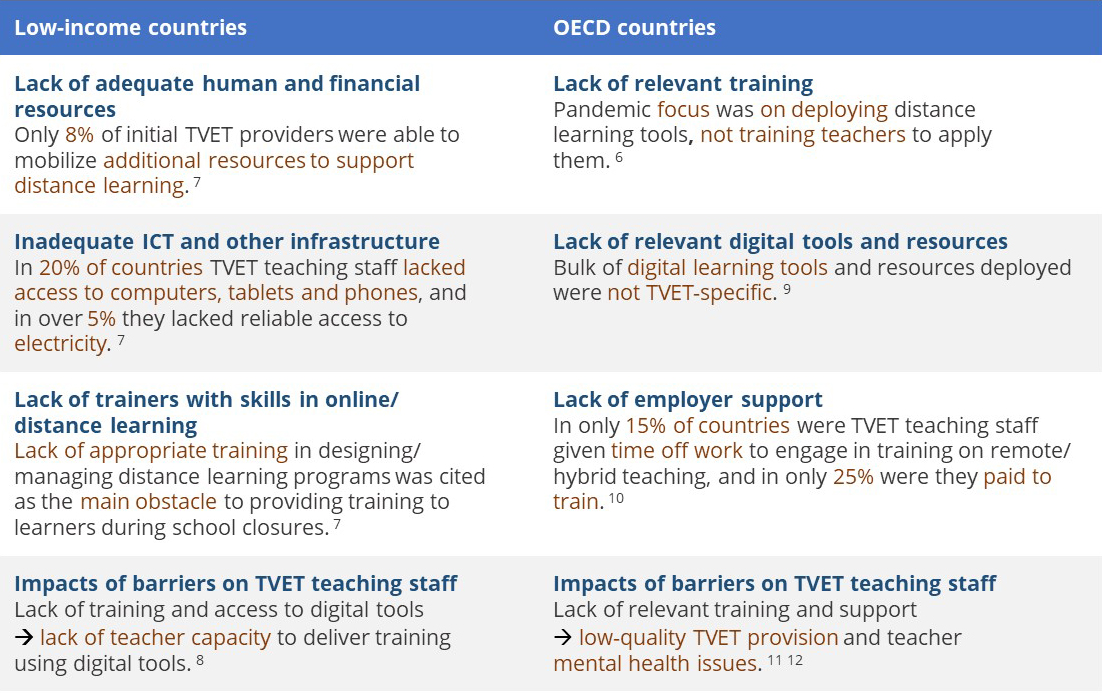
The barriers that TVET teachers and trainers have faced in acquiring relevant digital skills were broadly similar prior to and during the COVID-19 pandemic period, although the focus of TVET teacher digital skills development programmes has shifted from teaching teachers/ trainers how to use digital technologies for in-class teaching to training them how to use technology to deliver remote or hybrid training. During both time periods, the level and type of support available to TVET teaching staff has differed between low-income and high-income countries, and the supply-side barriers have contributed to demand-side barriers, affecting TVET teachers’/trainers’ willingness to participate in digital skills training and/or capacity to apply the digital skills they have acquired. The below tables also suggest that, although the main pre-pandemic barriers to TVET teachers’/trainers’ acquisition of digital skills for delivering TVET remotely have been set aside owing to the needs of the pandemic, they remain relevant.

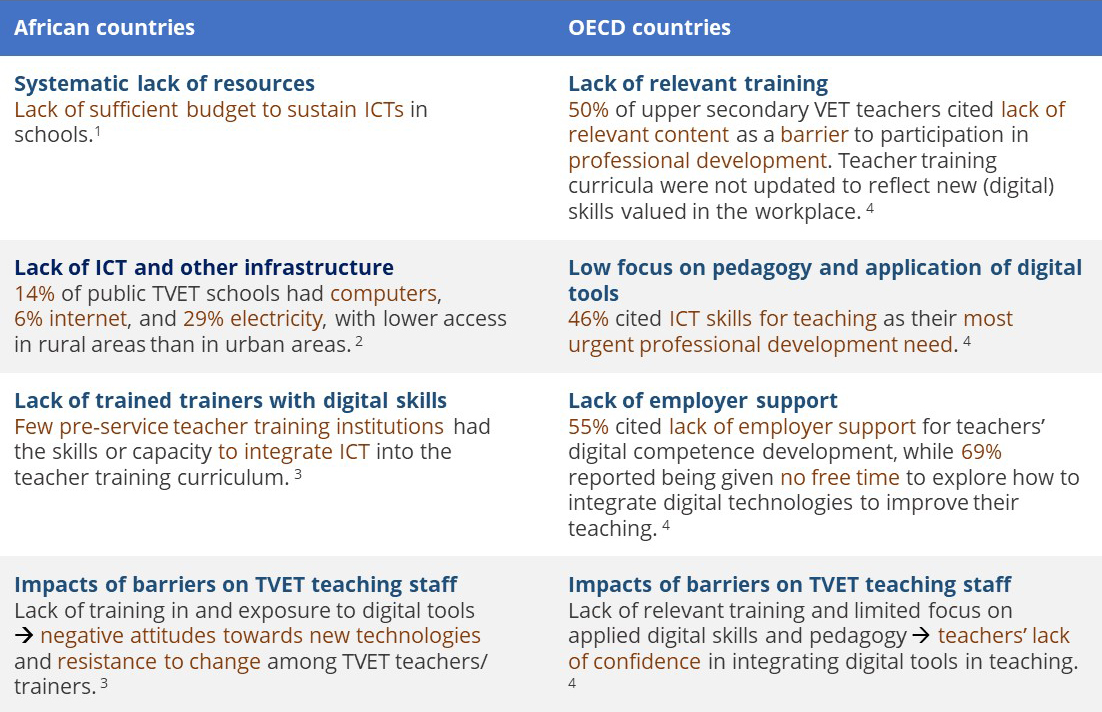
Main barriers to TVET teachers’/trainers’ acquisition of skills for integrating digital technologies in their teaching


Main barriers to TVET teachers’/trainers’ acquisition of skills for delivering TVET remotely


Main barriers to TVET teachers’/trainers’ acquisition of skills for delivering TVET remotely


Promising practice: Ideas Cube offline server and digital learning kit

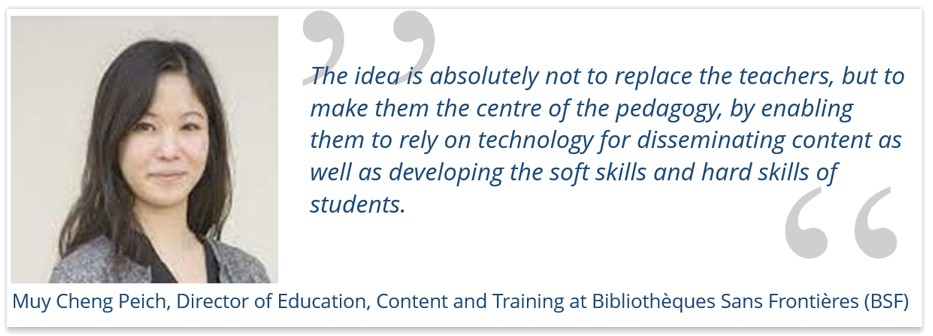
Bibliothèques Sans Frontières (BSF), an international NGO founded in 2007, aims to build bridges between the information society and those excluded from it. One of BSF’s main activities is to provide tailor-made support to educators in areas of the world where a large part of the population does not have access to the internet, using innovative technologies and teaching methods. Since 2019, BSF has been implementing offline digitalization projects to support quality improvements in TVET in Burundi and the Democratic Republic of the Congo (DRC). It has installed Ideas Cube kits in 13 vocational training centres across Burundi and in 15 technical education centres across DRC. The Ideas Cube is a portable nano-server that creates a local offline Wi-Fi hotspot to which users can connect using any device to access thousands of specially curated digital resources with no need for internet connectivity. When connected to the internet, the Ideas Cube updates and shares locally created content to the cloud. New resources can also be downloaded from an online catalogue. Ideas Cube kits contain the Ideas Cube server, 20 tablets, a laptop, a projector, a camera and (if needed) solar panels, which come neatly packaged in a small backpack or hardware box to optimize storage and protection from dust, heat and humidity, while allowing for easy recharging. The support that BSF offers to TVET teachers and trainers covers not only how to use its digital tools and contents, but also how to organize and facilitate learning activities to engage students and create an active learning environment. Pedagogy, together with digital tools and curated content, is central to BSF’s operations.


BSF's Ideas Cube offline server and digital learning kit


Explore UNESCO