


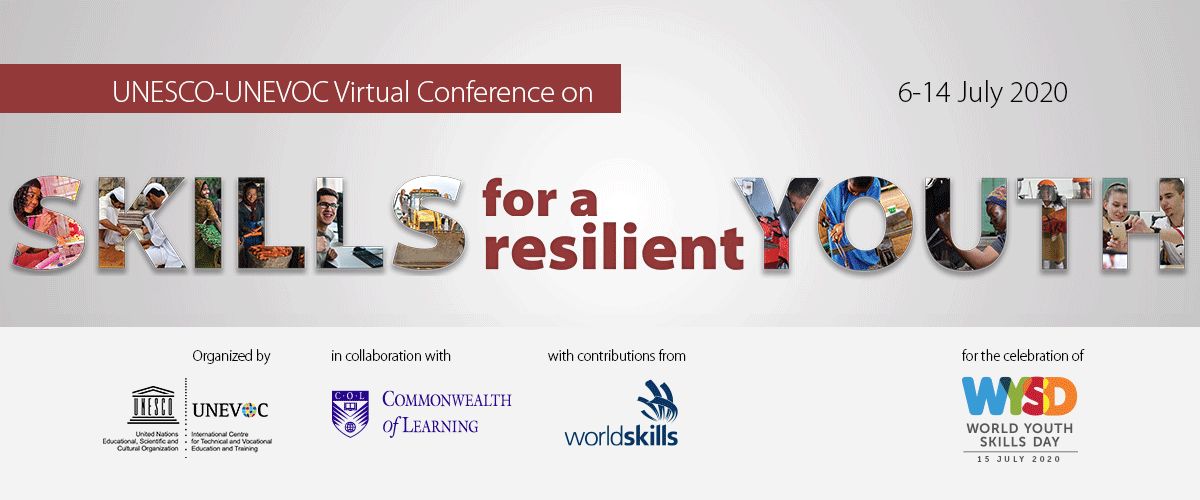



This virtual conference on Skills for a Resilient Youth was moderated by Terry Neal from the Commonwealth of Learning . It was organized as part of the celebration for World Youth Skills Day (WYSD) 2020, and coordinated by UNESCO-UNEVOC in collaboration with the Commonwealth of Learning.
Introduction
Every year on 15 July, the global community celebrates World Youth Skills Day. The day is an opportunity for young people, technical and vocational education and training (TVET) institutions, and public and private sector stakeholders to acknowledge and celebrate the importance of equipping young people with skills for employment, decent work and entrepreneurship.
World Youth Skills Day 2020 took place in a challenging context. The COVID-19 pandemic substantially affected education and training sectors worldwide in two ways:
- Institutional level. Lockdown measures led to the worldwide closure of TVET institutions and skills development organizations. UNESCO estimated that nearly three-quarters of the world’s learners were affected by school closures across education levels by early May. As distance education and training became the norm, the ability of TVET institutions to implement such systems depended on their capacity to adapt curricula as well as the preparedness of trainers and teachers.
- Systemic level. The economic recession triggered by the COVID-19 crisis led to a massive rise in un- and under-employment that could have a lasting impact on essential livelihoods. Transformations in the labour market will also result in changes in skills demands. TVET systems need to address the short- and medium-term impact of the current pandemic, in scaling up TVET solutions but also formulate responses that reflect long-term sustainability.
- Ensure that young people around the world continue to have access to quality education and training opportunities. This requires innovative TVET institutions that can adequately provide distance learning and flexible learning pathways.
- Identify future skills needs and develop responsiveness to short-, medium- and long-term impacts. Skills development stakeholders need to anticipate and respond to shifts in demands for labour-market skills as the predicted economic crisis unfolds and we understand the impact of the current pandemic on existing challenges, including youth unemployment, climate change and the transition to greener economies.
Format and agenda
Virtual conferences are asynchronous discussions that take place on the TVeT Forum. The moderator opens threads around specific topics and questions, and all participants are encouraged to contribute to the discussion by posting messages.
The following threads were opened for discussion on the days specified:
Expected outcomes
The virtual conference provided an opportunity for participants to:
- Assess the short-, medium-, and long-term impacts of the pandemic in different country contexts
- Share good practices from TVET institutions about how they responded to the pandemic. For example, how institutions provided distance learning in no-tech, low-tech and high-tech scenarios, and how teachers and trainers were supported
- Gain insights from private sector, employee, and employer stakeholders about the impact of the pandemic on their sectors, and the foreseen changes in job profiles and skills needs
- Learn from young people about their hopes and fears as well as the perceived opportunities moving forward
- Reflect on how TVET systems could respond to the short- and medium-term impact of the pandemic, while also keeping in mind longer-lasting challenges.
 Facebook
 Twitter
