





Discussion forum
Project documents
Network visualization map
Home: The i-hubs initiative | Project timeline | What is the i-hub? | Who are the i-hubs?
Recent developments: General Project News | News from the i-Hubs
Guided Self-Assessment: About | Calendar | Indicative Programme
Innovation Toolbox: The Balanced Scorecard | Skills and Innovation Ecosystem Map
Knowledge resources: Publications | Other useful resources
Networking for innovation: Discussion forum | Project documents | Network visualization map

TVET governance: steering collective action
This volume is written with the macrolevel or system-level stakeholder in mind. Macro level stakeholders can be any number of bodies with a mandate for collective action in TVET. This primarily covers ministries and statutory bodies with legally assi ...
 download
  read more
Strengthening technical and vocational education and training (TVET) is an important strategy to contribute to equitable, inclusive and sustainable economies and societies. Indeed, one of the Sustainable Development Goals focuses on ensuring ‘inclu ...
download read more 

The overarching aim of this project is to identify the digital skills requirements for the broader Australian workforce and examine the capacity of the vocational education and training (VET) system and industry training packages to effectively meet ...
download read more 
Understanding the return on investment (ROI) in VET provides governments with information on the performance of the system and justification for public expenditure. It can help enterprises and individuals to measure productivity improvement in firms ...
download read more 
Internationally, Australia’s tertiary education system, comprising the higher education and vocational education and training (VET) sectors, is highly regarded, with both sectors subject to ongoing national review and reforms. This paper explores i ...
download read more 
Understanding the costs and benefits of vocational education and training provides a basis for decision making regarding the investment in training. This is an important consideration for many stakeholders in the VET system, including individuals, bu ...
 view read more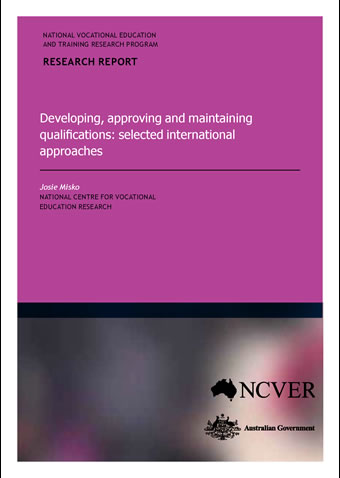
There are lessons for Australia in the key approaches to the development, approval, maintenance and quality assurance of qualifications adopted in countries overseas. This research takes into account a range of approaches used in selected European Un ...
view read more 
This study considers issues pertinent to ensuring the Australian education and training system can respond to emerging skills demand in the following industries: food and agriculture; biotechnology and pharmaceuticals; advanced manufacturing; mining ...
view read more
This study considers issues pertinent to ensuring the Australian education and training system can respond to emerging skills demand in the following industries: food and agriculture; biotechnology and pharmaceuticals; advanced manufacturing; mining ...
view read more
This report explores some of the key issues associated with assessment in vocational education and training (VET) and reflects on some possible solutions. The authors provide examples from three industry areas where concerns have been raised about th ...
view read more 
This report examines initial vocational education and training (VET) teacher training. It focuses specifically on teachers in institutional settings, particularly public and private VET registered training organisations (RTOs). The present project se ...
view read more 
This paper examines initial VET teacher training from the late 1979s to the present, based on the literature and the author's personal experiences. While much has changed, many of the issues and approaches that are apparent in the early literature re ...
view read more
This report identifies and analyses what drives and what creates barriers to effective implementation of recognition of prior learning (RPL). It has been prepared to provide advice to the National Training Quality Council on how best to support regis ...
download read more 




Stay in touch