




Discussion forum
Project documents
Network visualization map
Home: The i-hubs initiative | Project timeline | What is the i-hub? | Who are the i-hubs?
Recent developments: General Project News | News from the i-Hubs
Guided Self-Assessment: About | Calendar | Indicative Programme
Innovation Toolbox: The Balanced Scorecard | Skills and Innovation Ecosystem Map
Knowledge resources: Publications | Other useful resources
Networking for innovation: Discussion forum | Project documents | Network visualization map
 download
| Author/s: | UNESCO Bangkok |
| Publisher/s: | UNESCO Bangkok |
| Published: | 2017 in Bangkok, Thailand |
| ISBN: | 978-92-9223-581-9 |
| ISBN online: | 978-92-9223-582-6 |

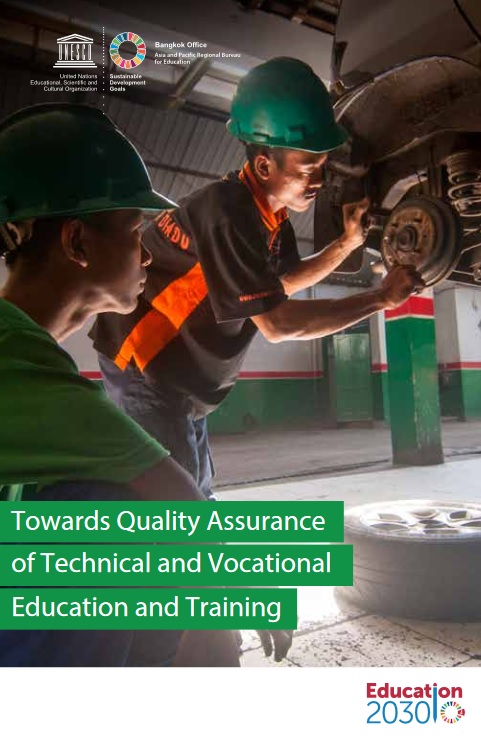
At the Third International Congress on Technical and Vocational Education and Training, held in Shanghai in 2012, a recommendation was made to explore the possibility of developing international guidelines on quality assurance for the recognition of qualifications based on learning outcomes. Developing such guidelines requires a fundamental appraisal of the quality assurance arrangements that are currently in place for TVET qualifications.
Following the recommendation in the Shanghai Consensus and considering the key role TVET plays in advancing the 2030 Agenda for Sustainable Development, particularly in the context of lifelong learning, countries in the Asia-Pacific region were invited to share their approaches to the quality assurance of TVET qualifications and collaborate in the production of regional guidelines on the subject. In relation to the Asia-Pacific region, exploring quality assurance and developing related guidelines is timely. With expanding socio-economic cooperation and integration within and between sub-regions, mechanisms for fair and transparent recognition of qualifications are needed to facilitate learning and labour mobility.
This synthesis report draws on studies from 13 participating countries in the Asia-Pacific region: Afghanistan, Brunei Darussalam, Cambodia, Indonesia, Lao PDR, Malaysia, Myanmar, the Philippines, the Republic of Korea, Samoa, Thailand, Tonga and Viet Nam. Experts and researchers from 12 of these countries prepared reports based on a common research framework.





Stay in touch