




Discussion forum
Project documents
Network visualization map
Home: The i-hubs initiative | Project timeline | What is the i-hub? | Who are the i-hubs?
Recent developments: General Project News | News from the i-Hubs
Guided Self-Assessment: About | Calendar | Indicative Programme
Innovation Toolbox: The Balanced Scorecard | Skills and Innovation Ecosystem Map
Knowledge resources: Publications | Other useful resources
Networking for innovation: Discussion forum | Project documents | Network visualization map

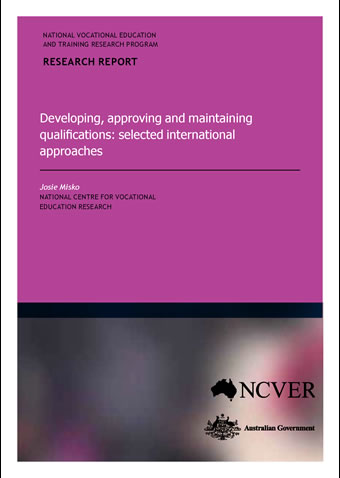
There are lessons for Australia in the key approaches to the development, approval, maintenance and quality assurance of qualifications adopted in countries overseas. This research takes into account a range of approaches used in selected European Union (EU) member states (Germany, Finland and Sweden), the United Kingdom (England, Northern Ireland and Wales, Scotland, and Ireland) and the nations of New Zealand, Singapore and South Korea. The processes used in Ontario, Canada, and selected accreditation agencies in the United States were also investigated.
This work serves to inform the vocational education and training (VET) sector in Australia about practices used overseas. It provides a useful reference document for agencies charged with developing and reviewing qualifications and showcases the different approaches used to ensure that qualifications remain current for the industries they serve.
Key messages
The report highlights some important issues for Australia, including:
- The introduction of qualifications frameworks, implementation of competency-based or learning outcomes approaches to learning and assessment, recognition of prior learning, and effective regulation and quality assurance processes are all being debated overseas, with varying solutions to the perceived issues being applied.
- The development of hierarchical national qualifications frameworks comprising progressively higher qualification levels is relatively widespread, and increasing. In the main, countries start with existing systems and review these to adapt to new concepts and practices. The use of credit accumulation or credit point systems based on the number of hours typically required for qualification completion is also prevalent.
- The referencing of national qualifications to regional framework models, especially in the European Union but increasingly discussed in our own region, is favoured for improving the transparency, portability, comparability and mutual recognition of qualifications. The main aims are to ensure that qualifications coming from overseas are of the same quality as those attained in the home country and to facilitate labour and student mobility.
- Collaboration between governments (or their delegated agencies) and industry stakeholders is key to developing and/or approving competency standards, educational standards and content that align with labour market needs. Stakeholders almost always involve representatives from industry; in some systems representation is also sought from education and training practitioners and experts, academics, professionals and community groups.
- Removing or retiring qualifications is an issue for systems where there has been a proliferation of qualifications. New Zealand and the United Kingdom have implemented systematic review processes which target for removal those qualifications that have experienced zero or very low uptake over a specified period of time (usually two years).
- Regulatory frameworks reflect their cultural and economic environments. The focus is increasingly moving away from top-down regulation (except for serious transgressions) to a system of collaboration between regulator and provider. Regulators provide advice on what is required to meet specific standards, and providers make internal arrangements to implement and monitor their progress against these standards. Self-appraisal is combined with regular or predetermined external evaluations by the appropriate government agency.
- Countries are keen to ensure that qualifications and skills gained are valued in the labour market by employers and students. This is done by aligning national qualifications and training needs with comprehensive labour market analyses, and applying outcomes-based quality assurance and/or inspection frameworks (including for equity groups). Rates of participation, qualification completion, employment, unemployment, movement into higher qualifications and progression through employment are some key indicators.
- There is a concern about the quality of teachers and teaching, in particular in the European Union states and the United Kingdom, with some countries increasing the level of qualification required for teaching in a VET institution or program.







Stay in touch