





Discussion forum
Project documents
Network visualization map
Home: The i-hubs initiative | Project timeline | What is the i-hub? | Who are the i-hubs?
Recent developments: General Project News | News from the i-Hubs
Guided Self-Assessment: About | Calendar | Indicative Programme
Innovation Toolbox: The Balanced Scorecard | Skills and Innovation Ecosystem Map
Knowledge resources: Publications | Other useful resources
Networking for innovation: Discussion forum | Project documents | Network visualization map
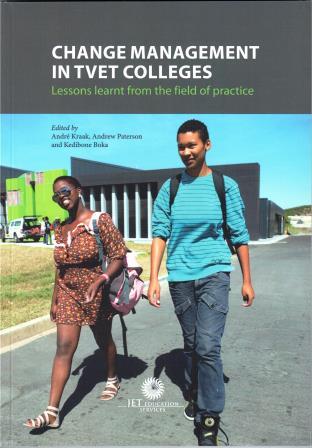
 Voir
Voir| Author/s: | André Kraak, Andrew Paterson and Kedibone Boka (eds.) |
| Éditeur: | Jet Education Services |
| Publié: | 2016 in South Africa |
| Licence: |  CC BY |

The Technical and Vocational Education and Training (TVET) colleges environment is marked by increasingly stark juxtapositions between what needs to be achieved in the post-school education sector and the increasing difficulty of current conditions. The ‘triple challenge’ of poverty, inequality and unemployment’ weighs heavily on the social, political and economic fabric of the country and expectations are high that the TVET colleges can make a pivotal contribution to counter these challenges
There is huge pressure to accommodate enrolment in colleges. In 2014, 71.3% of all unemployed people in South Africa were in the youth age group from 15 to 34 that is the biggest source of demand for post-school education. This amounts to more than 3.7 million people.
The TVET colleges are in a phase of unprecedented enrolment growth. Head count students numbers have risen from 325 000 in 2010 to 725 000 in 2015 and with a further substantial increase to 1 200 000 mooted by 2019. These figures are highly impressive as they stand.
Despite laudable increases in TVET enrolment, the education system needs to work harder to accommodate weight of demand for post school FET band qualifications from young people not in education, employment or training. At the same time it is vital to secure adequate quality in TVET programs which depend so much on the competence and commitment of college lecturers.
This collection introduces the following papers:







Stay in touch