

Discussion forum
Project documents
Network visualization map
Home: The i-hubs initiative | Project timeline | What is the i-hub? | Who are the i-hubs?
Recent developments: General Project News | News from the i-Hubs
Guided Self-Assessment: About | Calendar | Indicative Programme
Innovation Toolbox: The Balanced Scorecard | Skills and Innovation Ecosystem Map
Knowledge resources: Publications | Other useful resources
Networking for innovation: Discussion forum | Project documents | Network visualization map

The Salamanca Statement which was adopted at the World Conference on Special Needs Education in 1994 marked a watershed in the development of inclusive education. In addition, Sustainable Development Goal 4 on Education calls on Member States to ‘ensure inclusive and equitable quality education and promote lifelong learning opportunities for all’.
The upcoming UNESCO Global Education Monitoring Report on ‘Inclusion and Education’ (2020) – UNESCO’s flagship publication and comprehensive, analytical and authoritative reference for the global follow-up and review of education – puts particular focus on ‘the poor and the most disadvantaged, including working children, remote rural dwellers and nomads, and ethnic and linguistic minorities, children, young people and adults affected by conflict, HIV/AIDS, hunger and poor health and those with special learning needs’ (UNESCO, 2018, p.4).
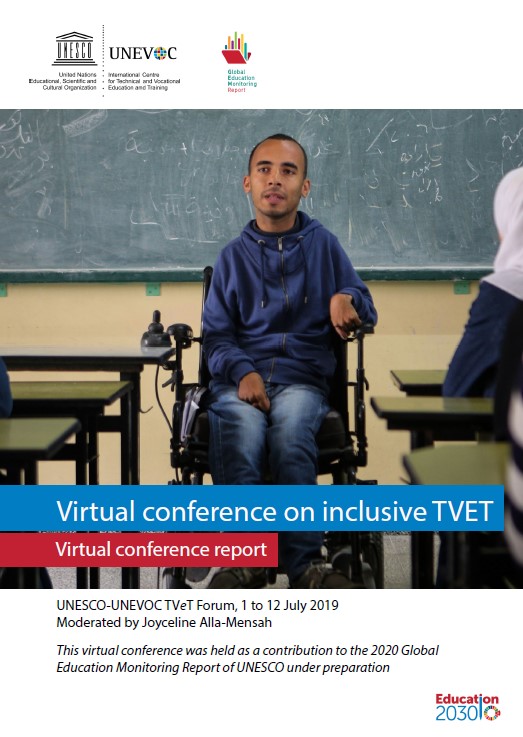
This report captures the outcomes of the virtual conference that focused on inclusion in TVET and provided an opportunity for the TVET community to discuss and share knowledge and experiences in this area. The conference enabled participants to understand different aspects of an inclusive system; from policies and strategies to learning environments and the role of stakeholders (as well as others).
Insights gained from the virtual conference will contribute to the preparation of the 2020 Global Education Monitoring Report on ‘Inclusion and Education’.





Stay in touch