




Discussion forum
Project documents
Network visualization map
Home: The i-hubs initiative | Project timeline | What is the i-hub? | Who are the i-hubs?
Recent developments: General Project News | News from the i-Hubs
Guided Self-Assessment: About | Calendar | Indicative Programme
Innovation Toolbox: The Balanced Scorecard | Skills and Innovation Ecosystem Map
Knowledge resources: Publications | Other useful resources
Networking for innovation: Discussion forum | Project documents | Network visualization map


In 2024, an estimated 116 million people required humanitarian assistance due to conflicts, climate change and public health emergencies (UN OCHA Annual Report, 2024). Amid escalating global crises, the education and training sector needs to respond quickly and strategically.
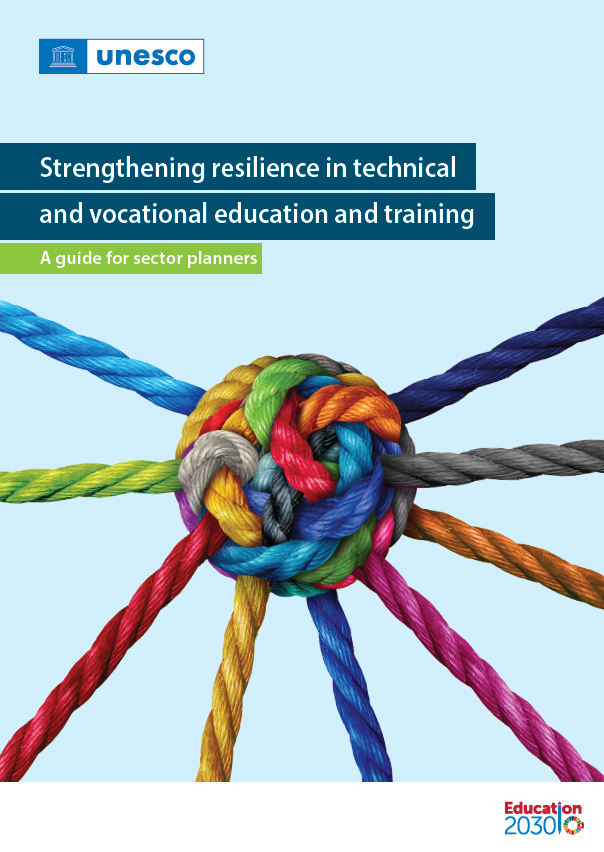
Strengthening resilience in technical and vocational education and training (TVET) is essential for navigating today’s complex challenges—from armed conflict and forced displacement to economic instability, digital disruption, health emergencies and climate-related disasters. TVET systems are uniquely positioned to equip individuals with the skills needed to adapt, recover and contribute to sustainable development.
As countries face an increasingly uncertain future, the capacity of TVET systems to absorb shocks and support learners, particularly the most vulnerable, depends on a sector-oriented approach that fosters inclusion, flexibility and long-term resilience.
This guide presents a learner-centred, system-wide model built around a readiness–response–recovery cycle. It provides tools to strengthen institutional adaptability, embed inclusive strategies and prepare TVET systems to meet the demands of a rapidly changing world.






Stay in touch