

 UNEVOC International Centre for TVET
UNEVOC International Centre for TVET
UNEVOC International Centre for TVET
Transforming technical and vocational education and training (TVET) for successful and just transitions


AdobeStock_268501217


AdobeStock_293522181
The world of work is undergoing major transformations caused by technological change, the effects of globalization, crises like the Covid-19 pandemic and migration among others. In the context of growing uncertainty in the job market, gig-economy, and the prospect of multiple careers, a strong entrepreneurial mindset is required for people to be able to adapt and thrive in fast-changing environments.
UNESCO-UNEVOC recognizes the importance of enabling entrepreneurship as a driver of sustainable economic growth, innovation and job creation, especially among small and medium-size enterprises. Preparing people to flourish in sustainable enterprises is therefore a priority for the whole education system and especially TVET, the education sector closest to the labour market (UNEVOC, 2020). TVET institutions are expected to emphasize the teaching of entrepreneurial competencies to prepare modern employees and innovative future entrepreneurs for post-pandemic recovery and sustainable societies.

AdobeStock_302071926
Entrepreneurial learning aims to promote creativity, innovation, and entrepreneurial mindset which equips youth to access and thrive in the world of work and supports their personal development. UNESCO-UNEVOC acknowledges the relevance of entrepreneurship education across the lifelong process, in all disciplines and to all forms of education and training, including formal, non-formal, and informal TVET (UNESCO-UNEVOC, 2020).
'1-career 1-lifetime' model is disrupted by technology, half of current work tasks will disappear due to automation.
WEF, 2020With the number of small and single employer businesses on the rise, SMEs represent about 90% of businesses and more than 50% of employment worldwide.
World Bank, 2020The creative economy is projected to reach around 10% of global GDP, with the cultural and creative industries employing more people aged 15-29 than any other sector. Nearly half of the people working in these industries are women.
World Bank, 2020BILT puts a focus on the importance of building entrepreneurial competencies and mindsets in TVET learners. The project is facilitating knowledge exchange on reimagining approaches to the identification of new qualifications and competencies, to dedicate more attention to generic skills and developing flexible, transferable, and learning-oriented skills and attitudes. Some of these competencies, such as problem-solving, critical thinking, active learning, and creativity are increasingly sought after by industries (WEF 2020).
Embedding entrepreneurial learning in TVET requires development of curricula that provide learners with real-life, active learning experiences. The institutions of the BILT community reflect on how to effectively implement new curriculum areas such as entrepreneurship education, which can be positioned as a cross-curricular subject, integrated into other subjects, or introduced as a standalone curriculum unit. This requires particular teaching approaches as well as changes to school organization and culture.
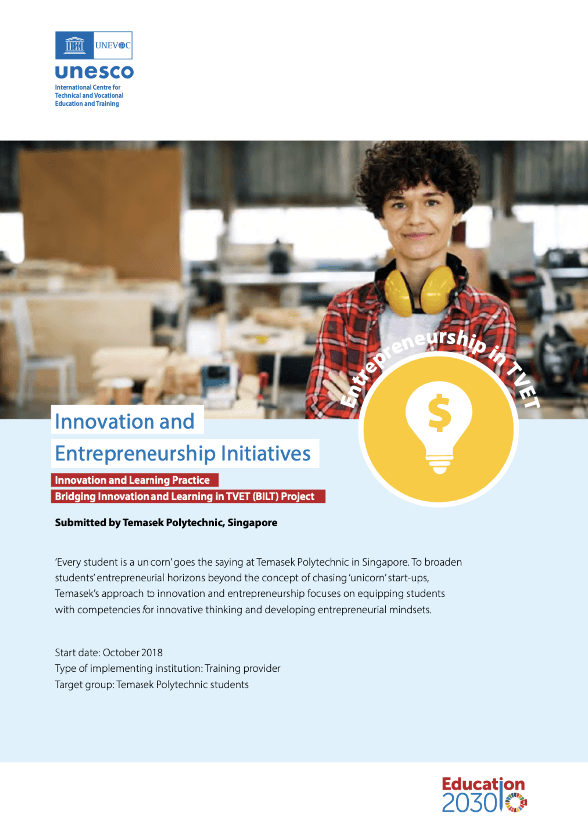
Innovation and Learning Practice 'Innovation and entrepreneurship initiatives', Temasek Polytechnic, Singapore implements a fundamental innovation and entrepreneurship curriculum for all students replicable by other institutions.
DownloadConsidering persistently high rates of youth unemployment worldwide, entrepreneurship is increasingly seen as an engine for economic growth and job creation in the 21st century. The self-entrepreneur is a creative thinker and an innovator, who is prepared to take risks, learn from their mistakes and make bold decisions (UNEVOC, 2020). TVET institutions of the BILT community are actively seeking strategies to unlock the innovation potential of future entrepreneurs. The establishment of incubation hubs such as FabLabs and Maker Spaces are an illustration of the support that TVET can provide to learners.
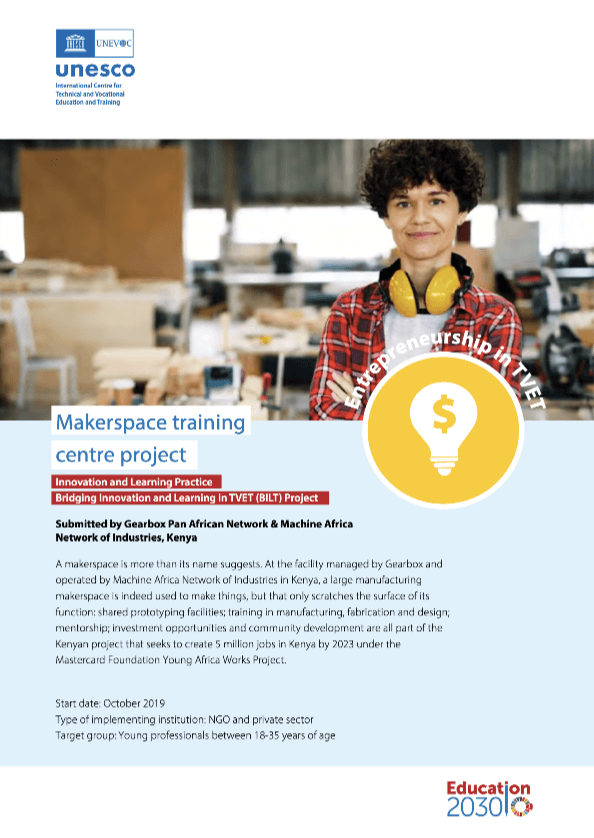
Innovation and Learning Practice 'Makerspace training centre project', Gearbox, Kenya provides young Kenyan inventors with manufacturing equipment and training to realize their concepts.
Download Facebook
 Twitter
