

 UNEVOC International Centre for TVET
UNEVOC International Centre for TVET
UNEVOC International Centre for TVET
Transforming technical and vocational education and training (TVET) for successful and just transitions


AdobeStock_223736266

AdobeStock_10058015
There are powerful forces shaping the world of work, including the climate crisis, rapid technological innovations, and challenges brought on by globalization. In this context, international migration and displacement continue to rise. Migration is a strong feature of the BILT regions, with Europe, Asia-Pacific and Africa hosting together 70% of the global international migrant stock (IOM, 2022). According to the World Migration Report 2022, most are moving for better work and life conditions (169M labour migrants), others to escape the impacts of conflict and political instability (26,4M refugees), as well as those displaced by recent climate- and weather-related disasters.

AdobeStock_67642976
The increase in migration is putting pressure on TVET stakeholders to provide adequate training solutions in order to facilitate the integration of this diverse and vulnerable group into host economies and societies. One of the central debates is about the competencies that education and training systems should provide. Often the most vulnerable groups in society, such as young migrants and refugees, are disproportionately affected by administrative, linguistic and practical barriers to training. Another challenge relates to enabling a better cross-border labour mobility though the establishment of regional qualifications frameworks and recognition of competencies that immigrants bring to destination countries before matching them with TVET offerings or jobs. TVET systems need to be supported to meet these challenges.
169 million labour migrants represent nearly 2/3 of international migrants globally.
IOM, 2022Lack of recognition, validation and accreditation of informal learning compromises refugees' ability to gain access to decent work or further education and training.
UNESCO GEM Report, 201917 regional qualifications frameworks exist at some stage of development around the world, only 3 of them are in line with all relevant national qualifications frameworks.
ETF, 2021The BILT project facilitates the debate on current and future competencies needed for successful inclusion of migrants and takes stock of the best practices in this field through its knowledge exchange and peer learning activities. The members of the BILT Community and other interested TVET stakeholders come together to discuss effective responses to the challenges faced by both host communities and migrants.
The webinar 'Ready to respond: TVET and refugees' explored effective ways of fostering refugees' labour market inclusion by providing access to tailored professional training.
Watch HereMigration and forced displacement trigger the need for flexibility, modularization, and support mechanisms in learning pathways. As individuals, migrants and refugees often require psychological and social support necessary for their reintegration. BILT Innovation and Learning Practices demonstrate how individualization of learning can be successfully achieved through the use of flexible, blended, and technology-enabled learning arrangements to cater to the needs of migrants and enhance their skills.
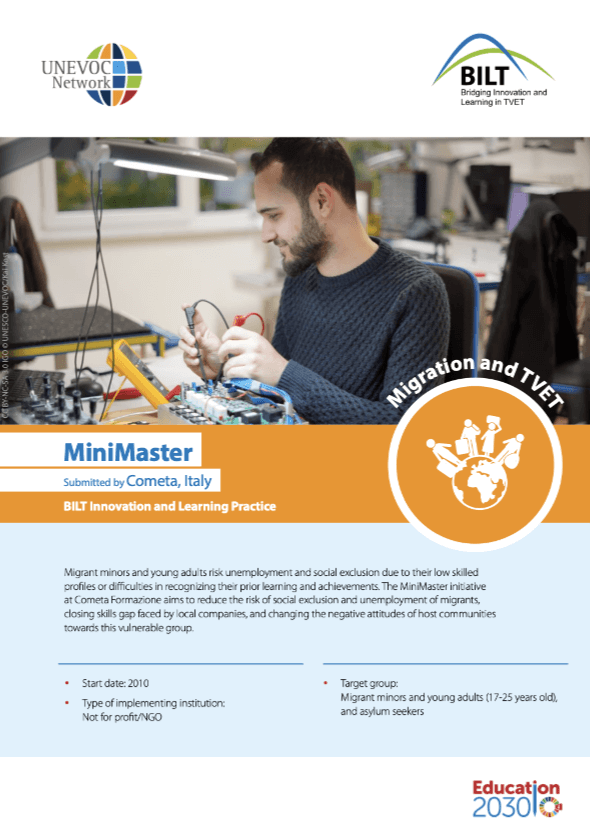
Innovation and Learning Practice 'MiniMaster' by Cometa, Italy reduces the risk of social exclusion and unemployment of migrants while closing skills gap faced by local companies.
DownloadRecognition of prior learning and qualifications from other countries is high on the TVET stakeholder agenda in the BILT regions, including the establishment of credit transfer mechanisms and recognition of prior learning systems. Establishing regional qualifications frameworks such as the European Qualifications Framework is essential to make labour migration possible and enable migrants' access to education and training and lifelong learning and can be used as a benchmark in implementing national qualifications frameworks, while supporting quality assurance and mutual trust across national qualifications.
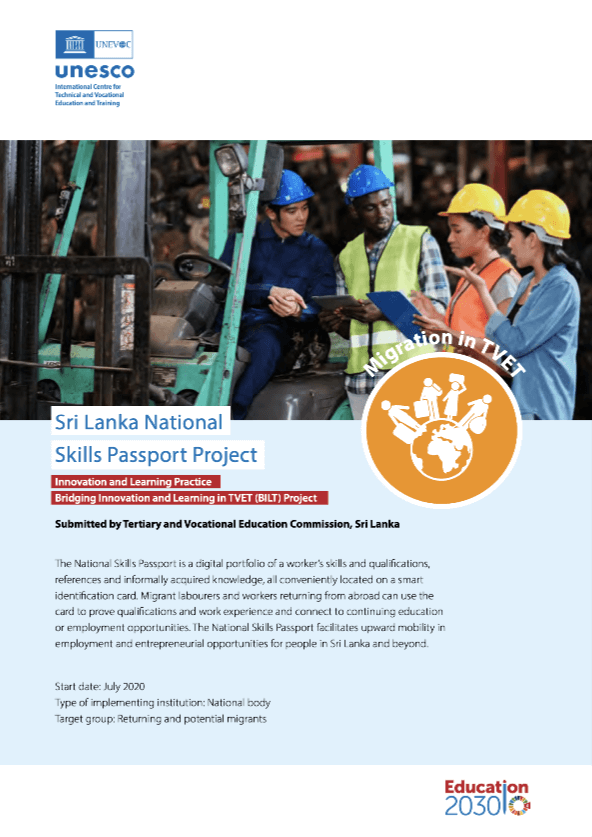
Innovation and Learning Practice 'Sri Lanka National Skills Passport Project' implements a cross-border digital skills portfolio tied to a Regional Qualifications Framework.
Download Facebook
 Twitter
