


Creating a comprehensive roadmap for green skills development in Thailand
This journey continued in September 2024 with a follow-up workshop in Bonn, Germany, aimed at deepening the exchange of knowledge and best practices. Representatives from Thailand participated in site visits to German training centres and vocational training colleges. The focus was on learning how Germany’s dual VET system and other international practices are modernizing vocational education, particularly in areas like development of green competencies for jobs and recognition of micro-credentials and sustainable qualifications in sectors such as agriculture, construction and hospitality.
On 16 September, the workshop kicked off at the UNESCO-UNEVOC office in Bonn. The opening sessions featured discussions on the essential elements of the requirements of a green transition, with insights shared by experts from UNESCO-UNEVOC, Germany’s GIZ and other organizations. This set the stage for understanding how Thailand can contextualize and adapt project-based, national or global strategies to its own green skills development.
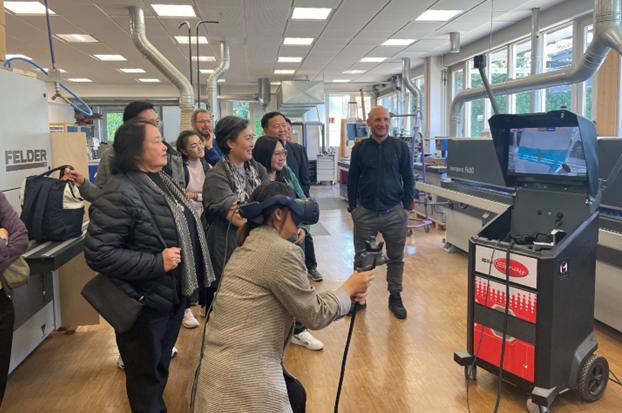
Over the next few days, participants visited different learning venues in and around Bonn, Germany. In Cologne, the group explored agricultural dual training programmes and met students and administrators who are actively engaged in agriculture and sustainable food production practices. Not only did the headmistress of the school of the Landwirtschaftskammer NRW (Chamber of Agriculture North Rhine-Westphalia) give a good background on how farmers learn in Germany, but three students also shared their personal journeys to becoming farmers.
At the Handwerkskammer (Chamber of Crafts) in Koblenz, participants witnessed how vocational education and training are adopting digital technologies and promoting environment-friendly practices at the same time, with a particular focus on trades like carpentry, construction, and metalwork. Participants were mesmerized when shown new ways of teaching TVET, such as a simulator for welding or a simulator for painting metals. The trainers explained that through the use of technology, training centres can simulate a work environment where students can learn and practice their skills. The use of these simulators in teaching and assessment entails significant reductions in the cost of training materials, and consequently reduced emissions and waste.
Another visit was to the Maritim Hotel in Bonn, where the participants were housed. During the study tour, the participants learned about the impressive efforts the hotel makes to be more sustainable: generating its own energy through the use of solar panels, providing safe habitats for bees, growing plants on the roofs, waste recycling in food preparation and service and recycling towels and bedsheets, amongst many other efforts. The participants also had a chance to meet a second-year trainee at the hotel, who shared her experiences.
A visit to Germany’s Federal Institute for Vocational Education and Training (BIBB) on 18 September offered deeper insights into the modernization of environmental professions. From water and wastewater management to hospitality, participants learned how sustainability competencies are being integrated into modern VET training programmes, providing an example for Thailand’s green TVET roadmap.
Further discussions centred on teacher training and industry partnerships to support the transition to a green economy. Experts from Canada, Germany, Spain and UNESCO-UNEVOC shared their experiences, helping Thailand to explore new pathways for collaboration and innovation in vocational education.
The visit spurred new ideas, comprised of top-down and bottom-up approaches. Among the more top-down approaches that will require policy support are the creation of a green TVET policy to guide institutions to perform their mandate better, the introduction of climate change and green concepts and skills from general education to post-general education levels and strengthening and facilitating teacher training, since they are key to passing on the learning and experience to their students.
Among the bottom-up transformation actions that can be implemented by the different TVET colleges under OVEC, while awaiting high-level policies to be developed, are the adoption of waste management disposal in school facilities, the integration of green skills in curricula and learning processes, establishing cooperation with community and society, and facilitation of visits to local Thai industries and companies that adopt green processes to better understand their demands.
The organization of competitions around green TVET implementation is also a planned action to provide incentives and create awareness on best practices and developments of a clear implementation plan by OVEC and TPQI to synergize their work. According to TPQI, greening practices as criteria for certifying training providers in Thailand could be an attractive course of action.
TPQI has emphasized moving TVET to the top of its agenda, which can be used to leverage the development of green workforces in Thailand within a shorter period. UNESCO-UNEVOC is prepared to provide continued support to the partners in Thailand to accelerate the greening of TVET in the country.
 Facebook
 Twitter
