for TVET. Scroll through the list, search for a term or select any of the filters below and click on submit. We welcome your suggestions to
to the list.
 Read more
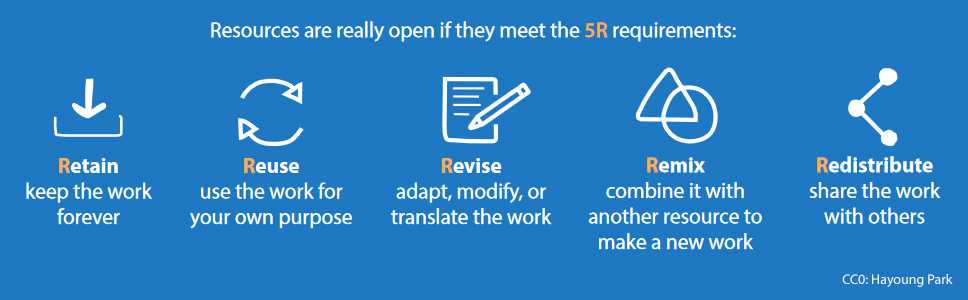
There is an enormous wealth of learning and training materials available online. Digital technologies and the internet allow for easy sharing of such resources. The example of Wikipedia shows the power of collaborative editing to jointly create open knowledge resources. However, most educational materials are still published under restrictive traditional copyright which does not allow for legal sharing and re-editing. The idea of open licensing aims to turn the copyright restriction around: Instead of always having to ask the copyright holder for permission, an open license explicitly specifies under what circumstances and conditions a work can be used and reused - it thus encourages the sharing of resources. Ultimately, it leads to
OER-enabled pedagogy
. In TVET the potential of OER and
Open Educational Practices is not yet realized. Access to high-quality TVET can be improved considerably if high-quality content would be made available under open licenses. OER can take many different forms: textbooks, curricula, syllabi, presentations and other course materials such as lecture notes, assignments, tests, audio, video and animations.

The term Open Educational Resources was first coined in 2002. Subsequent conferences recognized that OER can play a key role towards achieving the 2030 Agenda for Sustainable Development, and above all Sustainable Development Goal 4 on Quality Education. The 1st World OER Congress in 2012 called on governments to ensure that public spending results in the creation of public educational materials:
Governments/competent authorities can create substantial benefits for their citizens by ensuring that educational materials developed with public funds be made available under open licenses (with any restrictions they deem necessary) in order to maximize the impact of the investment.
(2012 Paris OER Declaration)
At UNESCO’s General Conference in November 2019 Member States adopted a
Recommendation on Open Educational Resources. This new standard setting instrument has
five objectives: (i) Building capacity of stakeholders to create access, use, adapt and redistribute OER; (ii) Developing supportive policy; (iii) Encouraging inclusive and equitable quality OER; (iv) Nurturing the creation of sustainability models for OER; and (v) Facilitating international cooperation.
A study commissioned by UNESCO-UNEVOC in 2018 on OER in TVET found that the OER concept was still widely unknown among TVET stakeholders - while at the same time it is regarded as highly promising in terms of improving access to high-quality TVET. The brochure OER for skills development aims to help understand and utilize OER. It gives an introduction to Open Educational Resources, the history of the concept, and its current and potential use in TVET. The publication includes a brief summary of the study mentioned above, which was implemented by Robert Schuwer, OER Chair for OER, Fontys University, Netherlands, and his colleague Ben Janssen.
Background information on OER
1st and 2nd World OER Congress & OER Action Plan
The First OER World Congress, organized by UNESCO in full partnership with the Commonwealth of Learning (COL) in 2012, adopted the 2012 Paris OER Declaration which calls on governments worldwide to openly license publicly funded educational materials for public use.
The 2nd World OER Congress, entitled “OER for Inclusive and Equitable Quality Education: from Commitment to Action” was co-organized by UNESCO and the Government of Slovenia. It reflected the pivotal role OER can play toward achieving the 2030 Agenda for Sustainable Development, and above all Sustainable Development Goal 4 on Quality Education.
At this Congress, the Ljubljana Action Plan for Mainstreaming OER in support of SDG 4 was adopted.
This momentum for promoting OER culminated with the UNESCO Recommendation on OER, which was adopted unanimously by the UNESCO General Conference in 2019. As of today, the Recommendation is the only existing international standard-setting instrument on OER.


 Read more