



OER: Open Licensing of educational content
 An enormous wealth of resources is available on the web that can be used for educational purposes. A lot of them can be accessed easily and for free, and a growing number of materials is explicitly licensed as OER. This means that such resources can not only be used for free, but are open: Truly open educational resources allow for full use, re-use, adaptation and re-sharing by learners and educators (5 R’s of Openness).
Open Educational Resources (OERs) are any type of educational materials that are in the public domain or introduced with an open license. The nature of these open materials means that anyone can legally and freely copy, use, adapt and re-share them. OERs range from textbooks to curricula, syllabi, lecture notes, assignments, tests, projects, audio, video and animation.
Licensing Resources for open use
The most widely used model for open licensing of resources has been created by the Creative Commons organization. The Creative Commons licensing model allows creators of works to keep their ownership yet at the same time defining under which conditions their work can be openly used. The following picture provides a good overview of the various CC licenses and the possibilities of combining them:
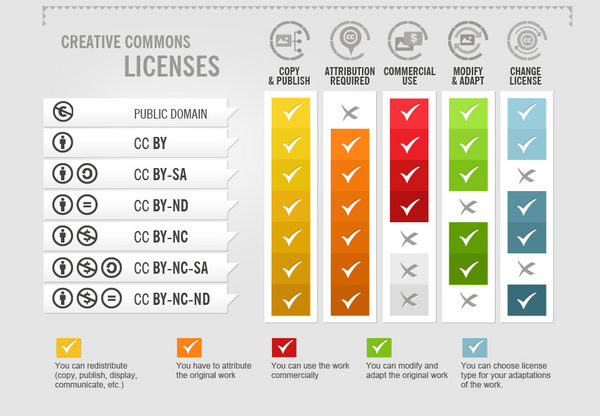
From: How To Attribute Creative Commons Photos by Foter, CC BY 3.0
http://foter.com/blog/how-to-attribute-creative-commons-photos/
Milestones in the OER movement
- Coining of the term in 2002, at a UNESCO Forum on Open Courseware (see UNESCO 2005, A Basic guide to open educational resources (OER))
- 1st World OER Congress 2012, Paris, with 2012 Paris OER Declaration
- 2nd World OER Congress 2017, Ljubljana, with OER Action Plan
- 3rd World OER Congress 2024, Dubai, Dubai Declaration of OER
- The 2019 UNESCO Recommendation on Open Educational Resources (OER): supporting universal access to information through quality open learning materials
Acknowledgements

