


 UNEVOC International Centre for TVET
UNEVOC International Centre for TVET
UNEVOC International Centre for TVET
Transforming technical and vocational education and training (TVET) for successful and just transitions

The International Day of Women and Girls in Science, celebrated on 11 February, is implemented by UNESCO and UN Women, in collaboration institutions and civil society partners that aim to promote women and girls in science. This Day is an opportunity to promote full and equal access to and participation in science for women and girls.
Gender equality is a global priority for UNESCO, and the support of young girls, their education and their full ability to make their ideas heard are levers for development and peace. Tackling some of the greatest challenges of the Agenda for Sustainable Development -- from improving health to combating climate change -- will rely on harnessing all talent. That means getting more women working in these fields. Diversity in research expands the pool of talented researchers, bringing in fresh perspectives, talent and creativity. This Day is a reminder that women and girls play a critical role in science and technology communities and that their participation should be strengthened.
Girls and women are particularly under-represented in fields requiring science, technology, engineering and mathematic (STEM) skills and knowledge. According to UNESCO's groundbreaking report Cracking the code: Girls’ and women’s education in STEM, only 35% of STEM students in higher education globally are women, and differences are observed within STEM disciplines. This under-representation is significant and detrimental to both individuals and society. In addition to being required for ‘traditional’ and ‘emerging’ occupations, STEM skills and knowledge are often needed for the so-called ‘jobs of the future’.
STEM-related technical and vocational education and training (TVET) has a significant role to play in providing the skills and competencies required to support innovation, productivity and international competitiveness. UNESCO-UNEVOC conducted a study on boosting gender equality in science and technology throughout 2019 and 2020. The report on this study was published at the end of 2020 and provides an overview of gender disparities in STEM-related TVET for ten countries. The ten case countries were selected in collaboration with members of UNESCO’s global platform of TVET institutions,the UNEVOC Network.
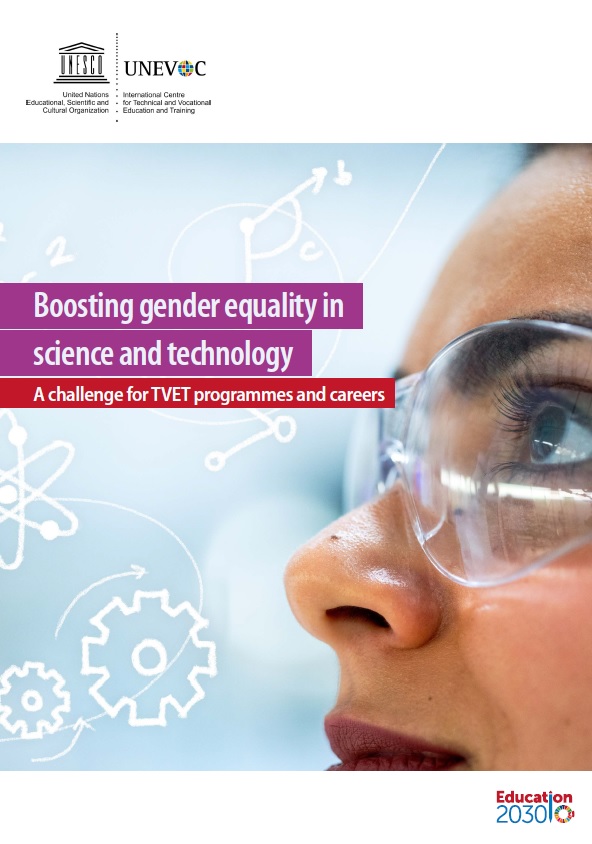

A challenge for TVET programmes and careers
While technical and vocational education and training (TVET) has the potential to bolster the participation of women in the labour market, this potential is not always well understood and capitalized on. In general, female students are lowly represen ...
 download
  read more
