


Key takeaways
BILT Learning Labs are an opportunity for TVET stakeholders to explore and exchange on specific Innovation and Learning Practices from Africa, Asia and the Pacific, and Europe.
The 2024 Learning Lab webinar series was implemented in collaboration with the Niagara College of Applied Arts and Technology and focused on the role of TVET in the transition to clean energy. It fostered inter-regional exchange over four distinct episodes.
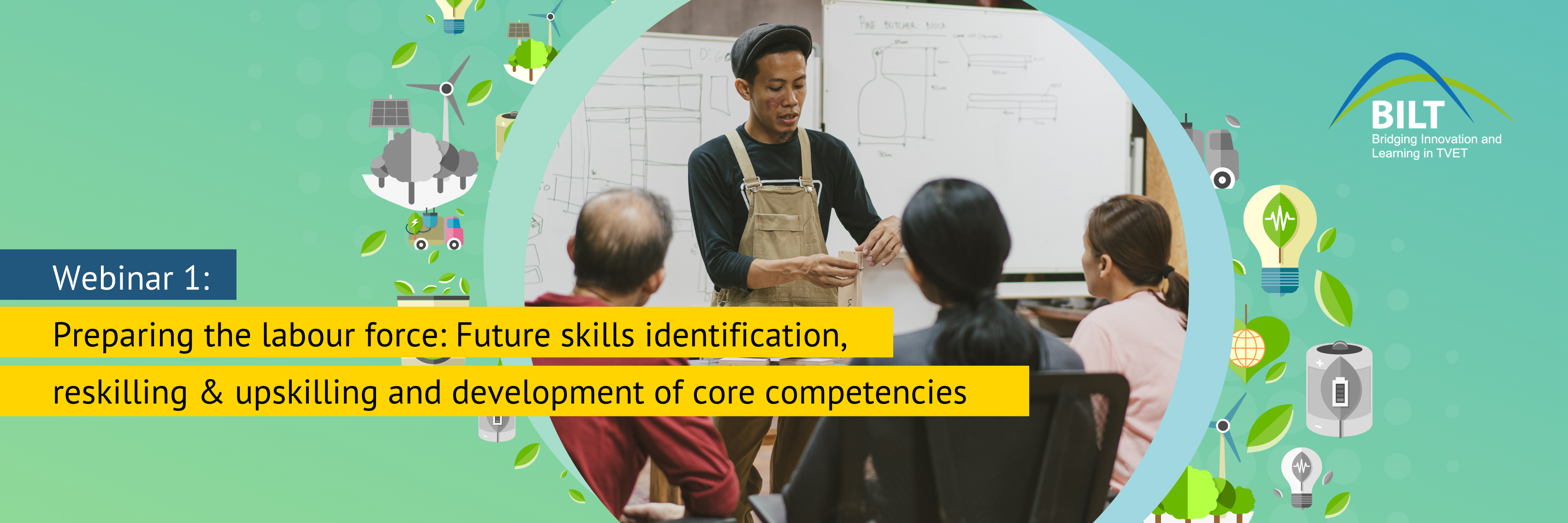
Webinar 1. Preparing the labour force: Future skills identification, reskilling, upskilling and development of core competencies
In this webinar we delved into skills and competencies required for the future clean energy workforce. Our speakers discussed policy perspectives and strategies for reskilling and upskilling workers from both international and national perspectives. They further explored the role of TVET institutions in developing these competencies, including some practical examples.
Goals:
- Understand the relevance of TVET in the context of a green energy transition.
- Get to know different international, regional and national approaches to future skills identification.
- Discover effective strategies and best practices for reskilling and upskilling existing workers to meet the demands of the green economy.
Agenda
The webinar was held in English from 09:00-10:37 CEST on 2 July 2024.
Moderation: Ms Maureen Souply, Niagara College Global Education and Training Consultant, Canada
Welcome and opening
- Mr Friedrich Huebler, Head, UNESCO-UNEVOC (0:42)
What skill will be most crucial for the clean energy workforce in the next decade?
- Ms Maureen Souply, Niagara College (3:04)
- Ms Kenneth Barrientos, UNESCO-UNEVOC (8:52)
- Ms Hae-Kyeung Chun, ILO (19:16)
- Ms Gabriela Prata Dias, UNEP (38:18)
- Mr Tobias Maier, BIBB (29:23)
- Ms Lalithaa Maniam, SkillsFuture SG (58:10)
Does your country or region have a strategy for identifying and addressing future skills in the green energy sector?
- Ms Maureen Souply, Niagara College (48:59)
1. What are the key challenges in reskilling and upskilling the existing workforce for the clean energy transition and how can TVET policies address these challenges effectively?
2. What strategies can be employed through policy development to guarantee that marginalized and underserved communities have access to the necessary training and opportunities?
- Ms Kenneth Barrientos, UNESCO-UNEVOC
- Ms Hae-Kyeung Chun, ILO
- Ms Gabriela Prata Dias, UNEP
- Mr Tobias Maier, BIBB
- Ms Lalithaa Maniam, SkillsFuture SG
- Ms Maribel Illig, HWK-OWL (1:13:47)
- Ms Victoria Hepplenthwaite, Wits University (1:24:55)
- Ms Maureen Souply, Niagara College (1:34:22)
- Ms Katharina Engel, Project Manager BILT, BIBB (1:34:52)
Full webinar recording
This Learning Lab webinar series was implemented in collaboration with the Niagara College of Applied Arts and Technology, Canada

Presentations
- Kenneth Barrientos, Programme Officer, Team Leader for SDGs and Greening TVET, UNESCO-UNEVOC, Germany
- Hae Kyeung Chun, Technical Officer, Skills and Employability Branch, Employment, ILO, Switzerland
- Lalithaa Maniam, Assistant Director, SkillsFuture SG, Singapore
- *Maribel Illig, Managing Director, Chamber of Skilled Crafts Ostwestfalen-Lippe zu Bielefeld (HWK-OWL), Germany
- Gabriela Prata Dias, Head of the Copenhagen Centre on Energy Efficiency (UNEP Copenhagen Climate Centre), Denmark
- Tobias Maier, Federal Institute for Vocational Education and Training (BIBB), Germany
- Victoria Hepplenthwaite, Researcher, University of the Witwatersrand Johannesburg (Wits), South Africa

