To give some background. The digital transformation impacts all aspects of TVET delivery, from the integration of new digital skills and competencies into teaching and learning processes to the organization of learning itself. Learners, both young and adult, must be equipped with digital skills needed for new and old jobs and to become digitally competent, capable, literate, intelligent citizens. TVET provision is under pressure to utilize digital technology to be more accessible, affordable and individually tailored while improving its quality and labour market relevance. The elements of this transformation can be broadly categorized as:
- Changes to teaching and learning, and delivery processes: how newly available, and constantly iterating, digital tools transform teaching and learning processes. Examples include utilizing technology to simulate, gamify and adapt to individual learner preferences while also creating a safer, stimulating and practical-oriented learning environment. Another aspect of change is the capacity to deliver TVET differently through combinations of remote and onsite learning opportunities taking place synchronously or asynchronously.
- Changes to the organizational management of learning within TVET providers: the use of digital tools, and the data they generate, to improve TVET providers’ organizational functions. Examples include being able to manage more learners pursuing varied bite-sized courses which can be coordinated in blended/hybrid, synchronous and asynchronous formats, financed from various sources for a range of learners, and formally or informally accredited/certified. It is hoped that new digital tools and data will create an infinite combination of flexible, individualized learning pathways.
- Changes to the role of TVET providers within their education and labour market ecosystems and communities: the ability to create digital partnerships with local organizations by creating technology hubs which provide pooled resources, such as fab-labs and makerspaces, that are accessible to businesses and communities and attract new local investment and research and development opportunities.
No part of the TVET system is untouched by the 'digital transformation'. As highlighted by the 2023
Global Education Monitoring report
, digital technology
is an input; it is a means of delivery; it is a skill, and a planning tool. These multiple roles are also captured in the 2023 UNESCO report
Enhancing TVET through digital transformation in developing countries which presents a conceptual framework for the transformation.
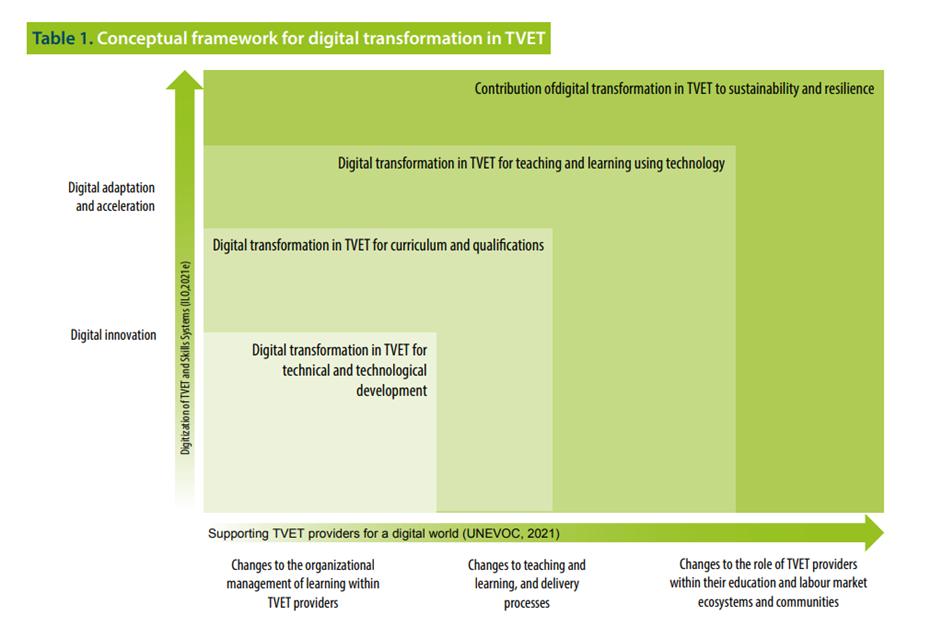
Supporting TVET providers and practitioners in this process is both a priority for policy and practice to meet UNESCO’s 2015 Recommendation concerning TVET which recognizes the crucial role of teaching staff in assuring TVET quality and relevance, and states that ‘policies and frameworks should be developed to ensure qualified and high-quality TVET staff, including teachers, instructors, trainers, tutors, managers, administrators, extension agent, guidance staff and others’. The digital transformation is an additional layer to be embedded in this process.
For more information on how to identify, integrate and implement new skills into TVET provision, see the UNESCO-UNEVOC Bridging Innovation and Learning in TVET Project.