Journée mondiale des enseignants 2020
Depuis 1994, la Journée mondiale des enseignants est célébrée le 5 octobre de chaque année. La célébration attire l’attention sur les contributions apportées par les enseignants à l’éducation dans leurs communautés et à l’instauration d’une société plus inclusive et durable.
En 2020, la Journée mondiale des enseignants aura pour thème "Enseignants: leaders en temps de crise et façonneurs d’avenir". Cette journée sera l’occasion de mettre la profession enseignante à l’honneur dans le monde entier, de faire le point des progrès accomplis et d’appeler l’attention sur la voix des enseignants, qui sont au centre des efforts déployés pour atteindre la cible mondiale de l’éducation: ne laisser personne de côté.
La pandémie de COVID 19 a considérablement accru les défis qui se posent partout dans le monde à des systèmes éducatifs déjà saturés. Il n’est pas exagéré d’affirmer que le monde se trouve à un carrefour et que nous devons, aujourd’hui plus que jamais, travailler avec les enseignants pour protéger le droit à l’éducation et le faire appliquer dans le nouveau contexte créé par la pandémie.
Activités de la Journée mondiale des enseignants de l’UNESCO
Cette année, compte tenu de la situation actuelle, les célébrations se dérouleront en ligne. En plus des cérémonies d’ouverture et de remise du Prix UNESCO-Hamdan, qui auront lieu le 5 octobre, et de la cérémonie de clôture, qui se tiendra le 12 octobre, une série de manifestations nationales, régionales et mondiales seront organisées tout au long de la semaine.
L’UNESCO tiendra une session intitulée Témoignage d’enseignants des programmes d’EFTP en temps de crise le 8 octobre de 14h00 à 15h30 (heure d’Europe centrale). Inscrivez-vous
ici .
.
Des informations complémentaires et le programme détaillé figurent ici.
Insights from the UNEVOC Network

Dr Ifeoma Akeredolu, UNEVOC Centre Coordinator
Yaba College of Technology, Nigeria
One necessary skill for the future is resilience. A teacher can only support students to build resilience by being a model of resilience themselves. Students should be encouraged to have a sense of meaning and purpose, to build positive relationships, and engage in collaborative activities with their peers.
 en savoir plus
There is a rapid increase in the need for learners to be skilled, rather than having a formal education alone. Resilience has been reported to have a positive influence on the academic performance of students. It is the duty of teachers to fulfill the need by incorporating skills-based learning in the curriculum to solve or meet the needs of the labour market. Identifying the individual strengths of students and helping them to use such optimally, is also a key element for their overall development.
Adapting to the COVID-19 crisis
In response to the COVID-19 crisis, my strategy has evolved from the face-to-face teaching of my students to facilitating their learning through digital platforms such as WhatsApp, Zoom and Google classroom. I have also kept them engaged with interactive assignments, projects and sessions that promote their understanding of the course material.

Alejandra Gardiazabal, Fashion Design Teacher
Duoc UC, Chile
If there's one thing the pandemic has taught us, it's that we're all connected. Our actions influence the lives of others, for better or for worse, and when we realize that, the responsibility each of us has to society becomes even more apparent.
en savoir plus
The future of education requires collaborative thinking:
- Students working as a team, connected with students from other institutions and other countries.
- Creating an environment of mutual trust so that students can feel comfortable and learn, whether this environment is virtual or physical.
Classes can no longer be lectures by experts, where students feel that the teachers are on a pedestal, far away. We have to encourage students to make the learning process their own, only then will they be able to fly with their own wings.
Adapting to the COVID-19 crisis
My strategy as a teacher has changed and adapted as the days and weeks have gone by, and we've realized that online classes are here to stay.
The first thing has been to listen with empathy: the students are scared, incredulous and distressed in this uncertain present. The second, to adopt an optimistic attitude. Optimism is contagious and with a positive attitude, we are all capable of learning better.
I have also had to develop my own digital skills. I would like to say that they were "rusty", but the truth is that in many cases, they were non-existent! The good thing is that since young people live in a much more digital world than we adults, they are also empathetic and patient with me. We have to learn from them too!
The evaluation for learning has become more important, the constant feedback as a guiding mechanism and the co-evaluation and self-evaluation, have been fundamental for students to acquire more confidence in their abilities and evolve more autonomously in the remote-learning process.
Finally, I believe that working in a collaborative way with my peers as well as with the students themselves is fundamental. By trying to find innovative solutions, new ways to present processes and results, adapted ways of working in teams, and giving feedback at every possible occasion, students see our concern for their learning and they appreciate it

Mariachiara Gomaraschi, Teacher
Cometa Formazione, Italy
Though I think we were forced to change, I do believe we also gained some structured methods from this situation, and in a sense, opened ourselves to new and effective teaching methods and learning tools.
en savoir plus
As teachers, I think the role we can play is the same we always have, asking students to work carefully and improve every day. I also think we can use any method, in particular I find it very important to encourage the questioning of reality and being open to change. Giving feedback to students, the more specific the better, helps them in shaping their knowledge and building their resilience.
Adapting to the COVID-19 crisis
The COVID-19 crisis was and has been a predicament for the school system, the length of lockdown and suspension of ‘in person’ schools could hinder or in some cases stop the ability to learn and study. For this reason, it became a necessity to develop some instruments to ‘see’ students even without seeing them in person. Furthermore, it was necessary to stop solely talking and dictating to students through cameras and start producing step-by-step activities in order to encourage students to work: read, write and talk to each other. Technology has come in handy, along with shared documents and presentations that have allowed us to reach and teach students.

Zhang Ying, Teacher
Zhejiang Institute of Economics, China
The future of education, in my opinion, is sure to be reshaped by COVID-19 towards a more digitalized trajectory. But Internet and AI technology will never replace human beings in terms of empathetic intelligence.
en savoir plus
I think teachers have two key roles to play. First, be a researcher of digitalized education. Teachers should conduct research collaboratively with governments, enterprises, and schools to ensure high-quality learning content, diverse learning activities, and effective learning outcomes when students learn online. Second, be an example of lifelong learning. Before COVID-19, I barely used any online teaching platforms or apps. But through learning and countless late nights, I succeeded in making DIY videos for classes, as well as switching flexibly between different online learning platforms. Students have been moved by my personal experiences and I’ve shown them that nothing is impossible as long as one keeps learning and putting in the effort.
Adapting to the COVID-19 crisis
In order to adapt to the “new normal” brought on by the COVID-19 pandemic, I’ve tried to shift my teaching strategies in the following three aspects.
Firstly, a shift from classroom-based teaching to internet-based teaching. I’ve worked out the most suitable internet-based platforms and tools in recording instructional videos, conducting live streaming lectures and giving feedback so as to foster learning and stimulate interest.
Secondly, a shift from teacher’s instruction to the construction of a learning community. Teaching methods, such as case studies, discussions, academic games or competitions, and student-led discovery, are all effective in helping students to learn through online collaborative interaction.
Thirdly, a shift from input-oriented evaluation to output-oriented evaluation. I’ve put more focus on enabling students to achieve outcomes that need adaptability, creativity, and collaboration to better prepare them for an ever-changing world.

Raja Mahmoud Hussein Ababneh, Trainer
Vocational, Training Corporation, Jordan
The repercussions of the coronavirus pandemic have cast a shadow over the whole world. Among them, the education and vocational training sector.
en savoir plus
Teachers can prepare, plan and respond to such difficult circumstances with the following:
- Develop rapid response plans based on past experience during the pandemic and make the most of it
- Upgrade the skills of trainers and staff working in different fields of training in interactive electronic learning materials for distance training
- Raise awareness about digital communication in society for such conditions to produce satisfactory results
- Establish systematic electronic platforms capable of integrating participants effectively
Adapting to the COVID-19 crisis
The current situation calls for solutions to change the pattern of the traditional training strategy. Furthermore, in order to maintain social distancing, solutions and alternatives are needed to change the training paradigm. Some of them are:
- Communicating with participants in training programmes and motivating them to share information with their workplace colleagues and trainers
- Creating virtual digital classes using the Google Classroom application and familiarizing trainers by sharing theoretical information and practical exercises
- Training through small groups to achieve social distancing and adapting to the epidemiological situation, and continuously taking all necessary measures of sterilization and wearing masks before and after the completion of training.
L’avenir de l’enseignement dans l’EFTP
Les bouleversements mondiaux – parmi lesquels le changement climatique, la numérisation, la quatrième révolution industrielle, le changement démographique et la migration – ont des répercussions sans précédent sur notre vie, le monde du travail et le monde de l’apprentissage. Les transformations qui en résultent, en particulier l’apparition de nouveaux rôles professionnels, appellent les apprenants à perfectionner sans cesse leurs connaissances, leurs compétences et leurs aptitudes pour affirmer leur position dans un marché du travail en rapide évolution. Ces changements font à leur tour évoluer non seulement le contenu et le format des programmes d’EFTP, mais aussi les méthodes d’enseignement et de formation (tant pratique que théorique) de l’EFTP.
Des réformes en cours ont abouti à une expansion des mécanismes de soutien aux enseignants de l’EFTP dans de nombreux pays, portant en particulier sur des pédagogies nouvelles, les curricula et le recours aux nouvelles technologies. Mais vu toute l’ampleur et la rapidité des changements sur le marché du travail, les prestataires de formation ne sont souvent pas à même de suivre le rythme ou de dispenser des compétences globales orientées sur l’avenir. En outre, il importe de motiver les enseignants et formateurs de l’EFTP à acquérir les connaissances, compétences, attitudes et valeurs requises pour se tenir au courant des changements sectoriels et méthodologiques.
Ces dernières années, les deux thèmes – l’avenir du travail et l’avenir de l’apprentissage – ont fait l’objet d’amples recherches et de larges débats dans le contexte des bouleversements mondiaux. Cependant, les implications des bouleversements mondiaux pour l’avenir de l’enseignement et de l’apprentissage dans l’EFTP n’ont pas encore été pleinement analysées, appréhendées et synthétisées dans un cadre d’action exploitable. On manque encore d’éléments probants et d’informations sur la manière de mieux organiser l’enseignement et l’apprentissage dans l’EFTP et de mieux aider les enseignants de l’EFTP à transmettre les compétences requises dans un marché du travail en rapide évolution et de plus en plus complexe. À titre de première étape de l’élaboration d’un cadre d’action exploitable pour améliorer la réactivité de l’EFTP aux futurs besoins de compétence grâce au renforcement des capacités des personnels de l’EFTP, l’UNESCO-UNEVOC a fait réaliser une étude pour identifier les tendances qui vont façonner l’avenir de l’enseignement et de l’apprentissage dans l’EFTP.
Le rapport intégral (en anglais) est disponible ici:


 en savoir plus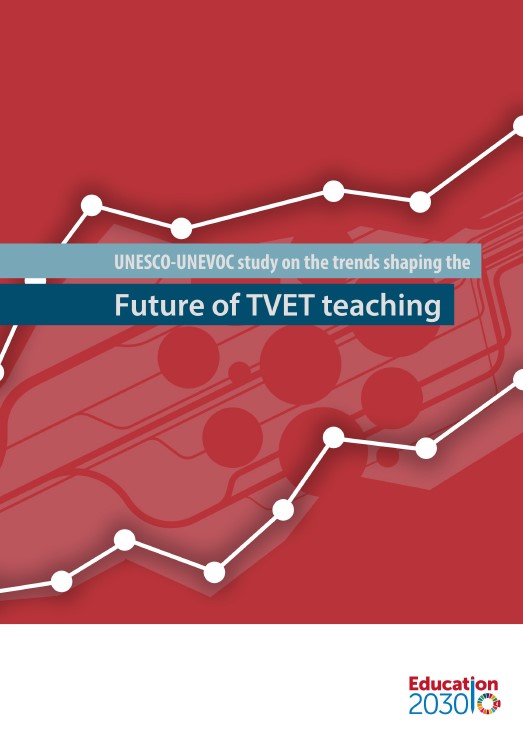

 télécharger
  en savoir plus
