


Pratiques innovantes et prometteuses dans l’EFTP
 En savoir plus sur les trois types de pratiques figurant dans notre base de données
 En savoir plus sur les trois types de pratiques figurant dans notre base de données
 Pratiques d’innovation et d’apprentissage – les pratiques d’innovation et d’apprentissage
  Pratiques innovantes i-hubs – les pratiques innovantes i-hubs sont compilées en collaboration avec les partenaires du projet "Skills for innovation hubs" et basées sur le concept d’innovation tel qu’il est décrit dans le
  Pratiques prometteuses – des pratiques d’EFTP du monde entier ont été mises en œuvre pour relever les défis émergents et contribuer à améliorer l’enseignement et l’apprentissage dans l’EFTP dans une perspective inclusive.
Training TVET instructors on the creation and delivery of online learning
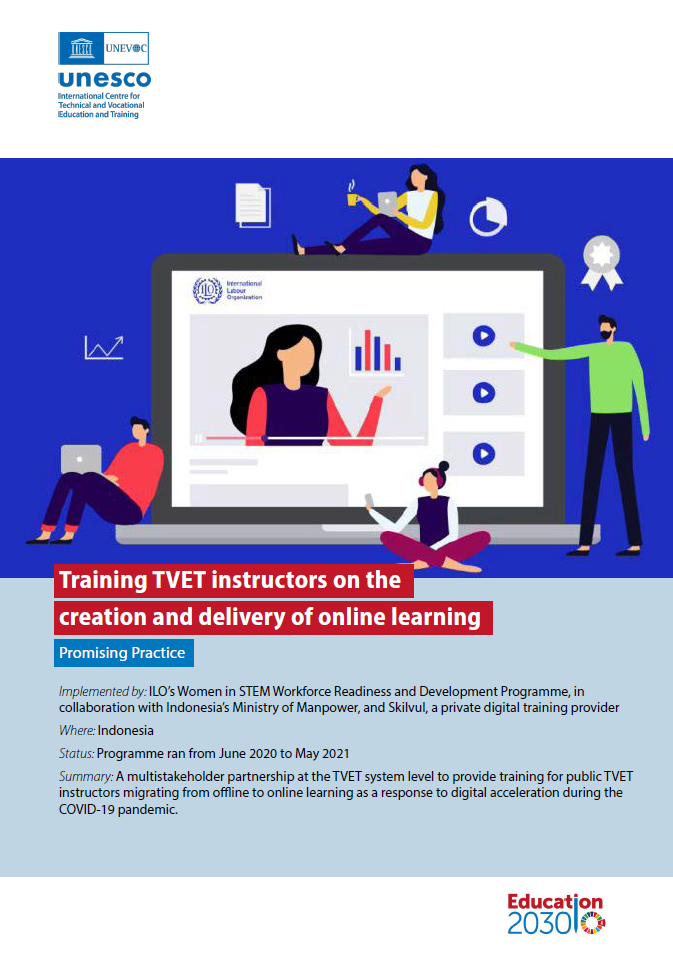
The ILO Women in STEM project team approached the Directorate of Instructors and Training Personnel Development within the Ministry of Manpower, which is responsible for the capacity building of teachers/trainers across Indonesia, to propose collaborating on a training programme for BLK instructors on the creation and delivery of online training.
The ILO team was also able to enlist the help of Skilvul, a training provider that had previously run face-to-face ‘boot camps’ in web programming for prospective coders and had been able to successfully shift its training model from offline to fully online when the pandemic hit. The result was an innovative and impactful initiative that has helped to advance digitalization in TVET teacher training and in TVET in Indonesia.
| Institution: | ILO’s Women in STEM Workforce Readiness and Development Programme |
| Pays: | Indonesia |
| Focus: | COVID-19 response , Digitalization and future of TVET , Teachers and trainers |

*Clause de non-responsabilité : l'UNESCO-UNEVOC ne cautionne aucune des pratiques incluses dans cette base de données et n'est pas responsable de leur gestion ou de leur mise en œuvre.

