


Pratiques innovantes et prometteuses dans l’EFTP
 En savoir plus sur les trois types de pratiques figurant dans notre base de données
 En savoir plus sur les trois types de pratiques figurant dans notre base de données
 Pratiques d’innovation et d’apprentissage – les pratiques d’innovation et d’apprentissage
 Pratiques innovantes i-hubs – les pratiques innovantes i-hubs sont compilées en collaboration avec les partenaires du projet "Skills for innovation hubs" et basées sur le concept d’innovation tel qu’il est décrit dans le
 Pratiques prometteuses – des pratiques d’EFTP du monde entier ont été mises en œuvre pour relever les défis émergents et contribuer à améliorer l’enseignement et l’apprentissage dans l’EFTP dans une perspective inclusive.

Enhancing TVET access in Small Island Developing States through AI and virtual reality
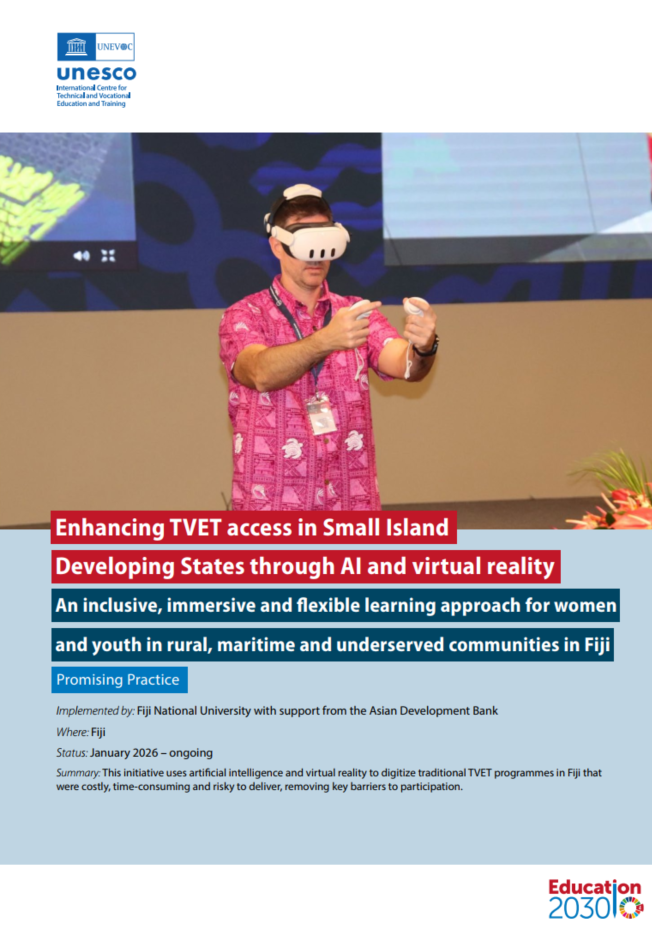
Fiji is a Small Island Developing State facing persistent challenges in delivering quality TVET to a geographically dispersed population. Limited physical infrastructure, high delivery costs and the safety risks associated with certain technical training areas restrict access to TVET, particularly for women and youth in rural and maritime communities. The integration of artificial intelligence (AI) and virtual reality (VR) into TVET delivery offers a promising response to these challenges, enabling flexible, immersive and inclusive learning that can reach communities where conventional delivery faces significant barriers.
The National Training and Productivity Centre (NTPC), the workforce development and productivity arm of Fiji National University (FNU), a UNEVOC Centre, leads this initiative as part of its mandate to build national workforce capability, improve productivity and support inclusive economic development. The initiative was developed under a project supported by the Asian Development Bank (ADB).
| Institution: | Fiji National University |
| Pays: | Fiji |
| Focus: | Digitalization and future of TVET , New qualifications and competencies , Teachers and trainers |

*Clause de non-responsabilité : l'UNESCO-UNEVOC ne cautionne aucune des pratiques incluses dans cette base de données et n'est pas responsable de leur gestion ou de leur mise en œuvre.


