


TVET professionals and policy makers around the world took part in BILT’s biennial learning forum from 7–9 December 2021. Some watched the sessions in the middle of the night, engaging in the online chat facility and networking in cyberspace. Experts, many from UNEVOC Centres in Africa, Asia-Pacific and Europe, offered participants a wealth of stimulating material about the future world of education and changing skill needs that are emerging from environmental and digital trends in the economy.
 VIDÉOS SOUS-TITRÉES EN FRANÇAIS
 VIDÉOS SOUS-TITRÉES EN FRANÇAIS
Among other relevant outputs, the first two years of the project resulted in a three-volume publication that examined how to identify, integrate and implement new qualifications and competencies for future-oriented TVET. The BILT project refers to this as the Three Is process. These volumes cater to the diverse needs of TVET-related institutions and offer a database of experiences and lessons from across the world.
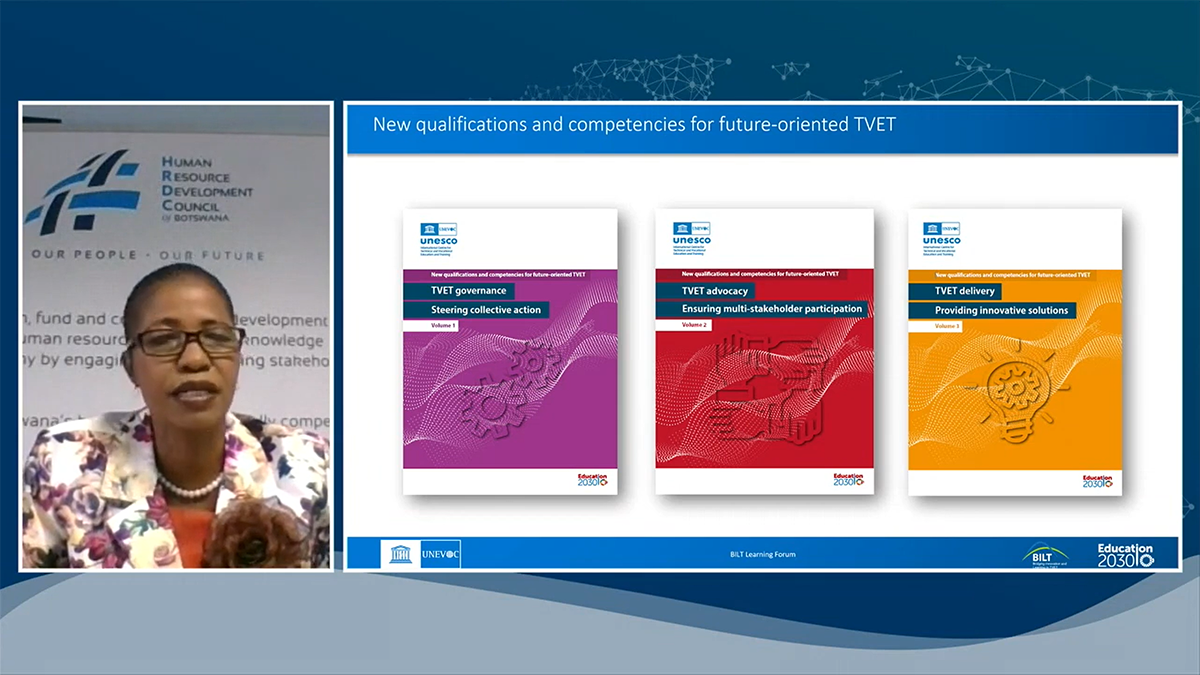
Ms Ellah Matshediso, Human Resource Development Council, Botswana launched the New qualifications and competencies for future-oriented TVET publication
Many of the presenters’ key messages about the fundamentals and challenges of creating a future-oriented TVET system re-emerged in different sessions of the conference.
- Evidence-based policymaking needs good data. Real-time information about labour market trends and job vacancies is making forecasting easier but these data should be combined with stakeholder engagement in research and analysis to deliver the best results. Moreover, policies need also to build in flexibility to allow people on the ground to tailor national guidelines to local conditions.
- Collaboration is key to futureproofing TVET. Industry partners have much to offer to make training relevant to the workplace. Their involvement should be not simply as customers of the system but as partners in training. Good data about the returns on investment in training can encourage employers to participate in apprenticeship schemes and in innovative learning delivery such as simulations and virtual reality platforms.
- TVET providers are at the frontline of implementing new qualifications and competencies. They need training and professional development to be able to deliver digital and green skills. This takes time and money.
It is not just about jobs. Future TVET programmes should aim to help all learners adapt to new societal trends and become active citizens. TVET has the potential to contribute to greater equality by helping to bridge the digital and gender divides and foster more inclusive societies.
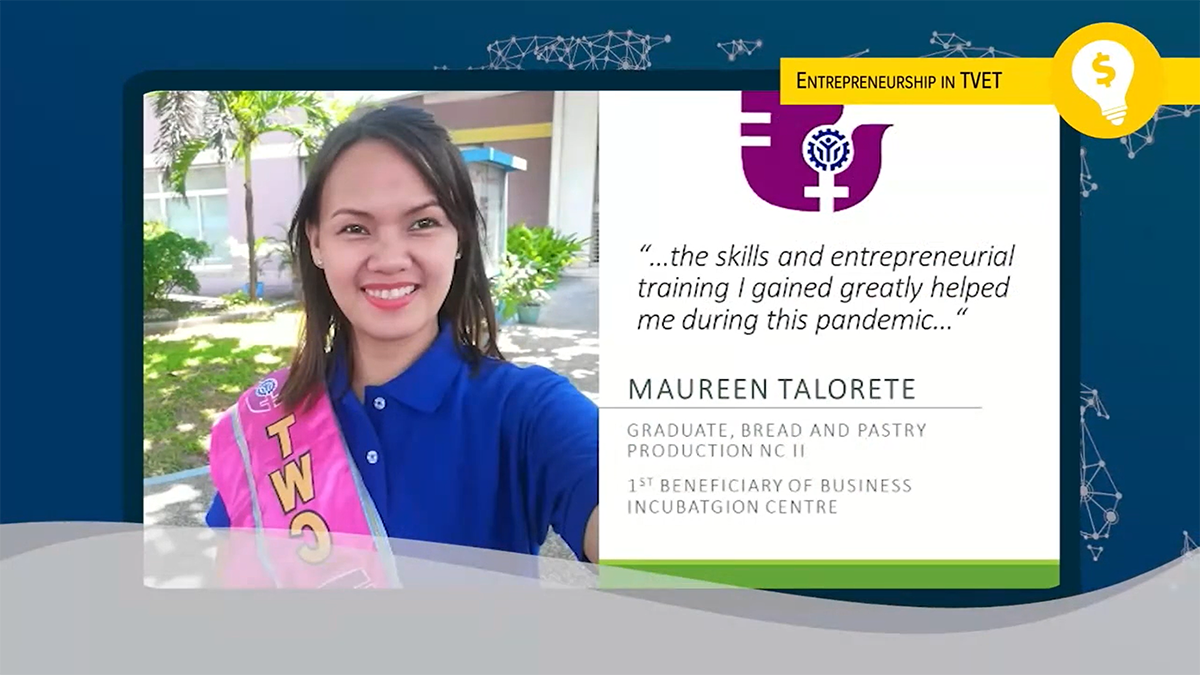
Ms Angelica S. Gonzales, Chief, TESDA Women's Centre, Philippines talked about the centre’s approach to empowering women through entrepreneurship training.
Thanks to continuing funding from the German Federal Ministry of Education and Research, or BMBF, the BILT project is now entering its third phase, where the dual transition of greening and digitalization of societies and economies will be the guiding theme. The BILT Agenda 2025 will further build partnerships among UNEVOC Centres and other interested TVET stakeholders from Europe, Africa, and Asia-Pacific.
TVET providers spearhead the Three Is process, yet their voices are not always as loud as other stakeholders. To drive the agenda forward, they need help. Therefore, the first concrete action in response to their demands is to turn the findings from the volume dedicated to TVET providers and alike into a self-reflection tool to assess how prepared these institutions are to contribute to the Three Is process. This initiative will be conducted with institutions from across the globe, which are the key to unlock the full TVET potential.
2022 will be another busy year!

Centre for Study and Research on Training and Qualifications, France
Human Resource Development Council, Botswana

Human Resources Development Service of Korea
Related documents and resources
- Watch our video on new qualifications and competencies

- Visit the BILT expert group on New Qualifications and Competencies
- Explore the BILT Innovation and Learning Practices and the Trends Mapping Study
- Browse the BILT Online Library

.focus();)
.focus();)
.focus();)
.focus();)
.focus();)
.focus();)
.focus();)
.focus();)


